

Uddiyana Bandha is a yogic abdominal lock practised after full exhalation to lift pranic energy upward through the Sushumna Nadi.
Uddiyana Bandha is a yogic abdominal lock performed after full exhalation to draw the abdomen inward and upward, stimulating the upward flow of pranic energy through the central energy channel, Sushumna Nadi. It is a key practice in Hatha Yoga, used to activate core muscles, support digestion, and direct subtle energy for higher yogic work.
The Sanskrit word Uddiyana means “to rise” or “fly upward,” and Bandha means “lock” or “seal.” This technique creates a vacuum effect in the chest, which lifts energy from the lower abdomen and helps awaken the body’s inner energetic system. It plays an essential role in cleansing kriyas like Nauli, Basti, and Vajroli Mudra.
The Hatha Yoga Pradipika highlights its significance:
“It is the lion that conquers the elephant, death. Of all the bandhas, Uddiyana is the best. Once it is mastered, liberation occurs spontaneously.”
— Hatha Yoga Pradipika, Chapter 3, Verse 57
Regular practice of Uddiyana Bandha strengthens the diaphragm and abdominal region, improves digestive fire (agni), and prepares the body for advanced practices such as pranayama, dhyana, and kundalini awakening.
How to do uddiyana bandha (abdominal lock)
Uddiyana Bandha should always be practised on an empty stomach, preferably in the early morning. Beginners are advised to practise it in a standing position.
Before you begin
- Stop immediately if discomfort arises
- Stomach must be empty (at least 4–5 hours after meals)
- Practise in a calm, ventilated space
- Do not rush the breath
Step-by-step method (standing practice)
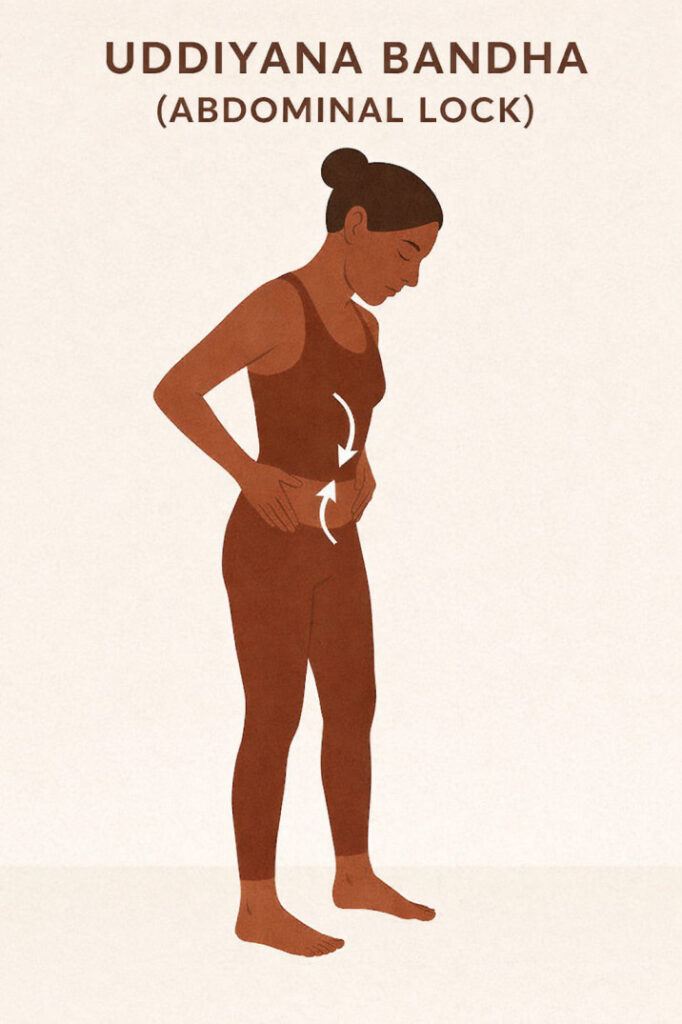
- Stand with feet about hip-width apart.
- Place your hands on your thighs, just above the knees.
- Inhale deeply through the nose.
- Exhale fully through the mouth, emptying the lungs completely.
- After exhalation, hold the breath out comfortably.
- Gently draw the abdomen inward toward the spine.
- Lift the abdomen upward under the rib cage without strain.
- Keep the chest open and the spine straight.
- Hold the position for 5–10 seconds (beginners).
- Slowly release the abdomen.
- Inhale gently through the nose and return to standing.
Repeat 2–3 rounds, resting between rounds if needed.
Sitting position
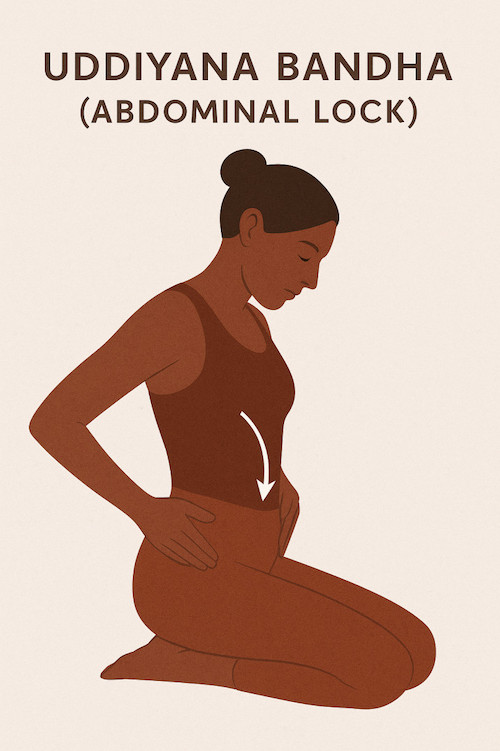
- Exhale completely through the nose or mouth until the lungs feel empty.
- Hold the breath out (external breath retention or bahya kumbhaka).
- Draw the abdomen inward, pulling the navel toward the spine.
- Lift the abdominal wall upward, creating a hollow space under the ribcage.
- Hold this position for a few seconds (as long as comfortable, without strain).
- Release gently, relax the abdomen, and slowly inhale to come out of the lock.
Note for Beginners:
If it’s difficult to lift the abdomen, try a mock inhalation expand your chest as if breathing in, without actually taking in air, while keeping your mouth and nose closed. This helps create the upward suction naturally.
Common mistakes and how to correct them
Many beginners struggle with Uddiyana Bandha not because it is difficult, but because it is misunderstood. Below are the most common mistakes and their correct approach, based on traditional yoga teaching.
- Always practise on an empty stomach. Wait at least 4–5 hours after eating before attempting this bandha.
- Let the abdomen move inward naturally after full exhalation. The lift happens due to breath retention, not muscle force.
- Hold the bandha only 5–10 seconds in the beginning. Increase duration gradually as comfort improves.
- Keep the face soft, jaw relaxed, and shoulders loose throughout the practice.
- Spend time learning full exhalation and breath awareness before practising the bandha.
Traditional teaching insight
In classical yoga instruction, students are first taught how to exhale completely before being introduced to Uddiyana Bandha. Without proper exhalation, the abdominal lock cannot form correctly.
This gradual approach protects the body and builds a stable foundation for advanced practices.
Contraindication & precautions
To practise Uddiyana Bandha safely and gain its full benefits, it’s important to follow these precautions.
- If you have high blood pressure, avoid practising Uddiyana Bandha, as it can cause a rapid increase in blood pressure.
- People with ulcers or hernia should also avoid this technique, as the abdominal pressure may worsen their condition.
- Pregnant women must not practise Uddiyana Bandha, as it may negatively affect both the mother and the unborn child.
- Avoid the practice during menstruation, as it can disrupt the natural downward flow of energy.
- Always practise on an empty stomach. Doing it after a meal may lead to stomach pain or indigestion.
- Do not push your body beyond its limit. If you feel discomfort or strain, gently release the lock. Overexertion can be harmful.
How Often Should You Practise Uddiyana Bandha?
Uddiyana Bandha should be practised according to your experience level and comfort. The practice must always feel controlled, calm, and effortless, never forced.
For beginners
- Practise once daily
- Perform 2–3 rounds
- Hold the bandha for 5–10 seconds
- Breathe normally between rounds
Beginners should focus on correct exhalation, breath awareness, and relaxation, not on increasing duration.
For intermediate practitioners
- Practise once or twice daily
- Perform 3–5 rounds
- Gradually increase the holding time as comfort improves
At this stage, Uddiyana Bandha may be combined with gentle Pranayama practices.
For advanced practitioners
- Practised as part of Nauli, Kriya Yoga, or advanced Pranayama
- Duration and number of rounds depend on capacity and guidance
Advanced practices should always be learnt under proper instruction.
Best time to practise uddiyana bandha
- Early morning is the most suitable time
- The stomach must be completely empty
- Practise after bowel movement, if possible
Morning practice helps stimulate digestion and creates a feeling of lightness and clarity throughout the day.
Difference between uddiyana, nauli & mula bandha
| Feature | Uddiyana Bandha | Nauli | Mula Bandha |
|---|---|---|---|
| Main action | Abdominal lift | Abdominal rotation | Pelvic floor contraction |
| Difficulty | Beginner–Intermediate | Advanced | Beginner |
| Main benefit | Digestion & energy lift | Organ massage | Energy stability |
| Breath | After exhale | After exhale | With breath |
Uddiyana bandha and pranayama
Uddiyana Bandha is not a breathing exercise. It is a yogic lock that is practised after complete exhalation. However, it plays an important supportive role in Pranayama practice.
In traditional yoga, bandhas are used to guide and control the flow of breath and energy, which is why Uddiyana Bandha is taught alongside Pranayama.
How uddiyana bandha supports pranayama
Uddiyana Bandha helps Pranayama practice by:
- Creating awareness in the abdominal and diaphragmatic region
- Supporting breath control during retention (Kumbhaka)
- Preparing the body for advanced breath techniques
- Reducing unnecessary tension in the abdomen
Because of this, it is often introduced before or alongside Pranayama, not during active inhalation or exhalation.
When to practise uddiyana nandha in relation to pranayama
- Practise Uddiyana Bandha first, on an empty stomach
- Follow it with gentle Pranayama if needed
- Do not perform the bandha during breathing cycles
This sequence helps prepare the body and mind for deeper breath awareness.
Uddiyana bandha(abdominal lock) benefits
Uddiyana Bandha engages the abdominal muscles and diaphragm, creating a powerful internal massage that improves physical strength, digestive function, and energy flow. Below are the key benefits of this yogic abdominal lock:
- Strengthens the Abdominal Region: Uddiyana Bandha acts as a natural workout for the abdominal muscles and diaphragm. It tones and strengthens the core, supports spinal health, and improves the movement of the diaphragm. This internal lock also massages the heart and lungs, enhancing their function and promoting overall vitality.
- Improves Digestion and Detoxification: The abdominal lift stimulates digestive fire (agni), which helps break down food efficiently and promotes the elimination of toxins from the body. With regular practice, it supports better metabolism and clears digestive sluggishness.
- Boosts Blood Circulation and Promotes Youthfulness: Uddiyana Bandha improves blood flow to the abdominal organs, brain, and heart. This enhanced circulation refreshes the nervous system, promotes mental clarity, and contributes to a feeling of lightness and youth.
- Balances the Vital Energies (Vayus): This practice reverses the downward flow of Apana Vayu (lower energy) and unites it with Prana Vayu (energy of the heart) and Samana Vayu (energy of digestion). This convergence of energies takes place in the region of the solar plexus (celiac plexus), activating the Manipura Chakra—the body’s energy and transformation centre. It enhances the function of all organs linked to this chakra and clears the path for inner awakening.
- Supports Kundalini Awakening: When combined with Moola Bandha, Uddiyana Bandha stimulates kundalini energy and channels it upward, helping to awaken the Anahata Chakra (heart centre). According to the Gheranda Samhita, this practice increases internal awareness and prepares the mind for dharana (concentration), dhyana (meditation), and ultimately, samadhi (absorption).
Conclusion
Uddiyana Bandha is a powerful yogic technique that strengthens the core, improves digestion, and activates the flow of pranic energy. By lifting the abdominal muscles after exhalation, it stimulates internal organs, purifies the energy channels, and prepares the body for deeper yogic practices. Rooted in classical Hatha Yoga texts, it is known for its ability to rejuvenate the body and awaken inner awareness. When practised with proper guidance and awareness, Uddiyana Bandha becomes a vital step toward physical vitality, mental clarity, and spiritual awakening.
FAQs
1. Is Uddiyana Bandha safe for beginners?
Yes, but it should be learned under guidance. Beginners should start in a standing position and avoid overexerting the abdomen.
2. Can Uddiyana Bandha reduce belly fat?
It tones the abdominal muscles and improves digestion, which may help reduce belly fat when combined with a healthy lifestyle.
3. How long should I hold Uddiyana Bandha?
Start with 5–10 seconds and gradually increase to 30 seconds, depending on your breath-holding comfort.
4. Can I do Uddiyana Bandha daily?
Yes, it can be practised daily on an empty stomach, preferably in the morning.
5. Does Uddiyana Bandha help with constipation?
Yes, it stimulates digestive organs and helps regulate bowel movements by improving digestive fire.
6. Is Uddiyana Bandha good for mental clarity?
Yes, it increases oxygen supply to the brain and balances energy flow, which enhances mental focus and clarity.
7. Can women practise Uddiyana Bandha?
Yes, but not during menstruation or pregnancy. Always consult a yoga expert for individual guidance.
8. What is the difference between Uddiyana Bandha and Nauli?
Uddiyana Bandha involves lifting the abdomen inward and upward, while Nauli is a dynamic movement of abdominal muscles using Uddiyana as a base.
9. Do I need to practise other bandhas with Uddiyana?
Advanced practitioners often combine Uddiyana with Mula Bandha and Jalandhara Bandha, but it’s not required for beginners.
10. Is Uddiyana bandha dangerous??
Uddiyana Bandha is safe when practised correctly on an empty stomach and within personal limits. Problems arise only when it is forced or practised despite contraindications.





Dear Sagar Will, you help me, please?
Right now I have the feeling I have reached the awakening of Kundalini since at least 15 years ago I attended an initiation by Baba Muktananda and I been doing sidha meditation since then OM NAMAH SHIVAYA. I am sure he gave me by shaktypath. But right now I am doing the 5 Tibetan exercises for the column and the control of the flying of prana or ki along the column WHICH I AM SURE IT IS HELPING ME WITH KUNDALINI, THEY SAY YOU MUST CONTROL YOUR SEXUAL ENERGY BY MEANS OF AN EXERCISE THEY DO NOT CALL IT UDIYANA BANDHA, BUT I AM SURE IT IS THE SAME. I FEEL GREAT BUT SINCE I HAVE A PROSTATIC ENLARGEMENT NOT CANCER
I AM SURE IT WILL HELP ME A LOT BUT I AM NOT SURE I KNOW THERE IS A PROSTATIC MASSAGE TO REDUCE THE INFLAMMATION, WILL UDDIYANA BANDHA HELPME? REALY I FEEL GREAT BUT AS A TEACHER OF YOGA, WHAT DO YOU SAY?
Hello, yes, as per your description about this Tibetan exercise it sounds more like a modified or renamed version of Uddiyana bandha since Uddiyana bandha draws Prana or Ki (energy) out of its foundation, the Muladhara Chakra, up through the spinal column, hence awakens kundalini.
In the case of prostate enlargement, I admit it Uddiyana bandha will help you but more effective than this would be Mula Bandha (root lock). The mula bandha can relieve the tension created in the pelvic floor region due to prostate enlargement. In its practice, the perineum is gently contracted and released in a rhythmic manner.