
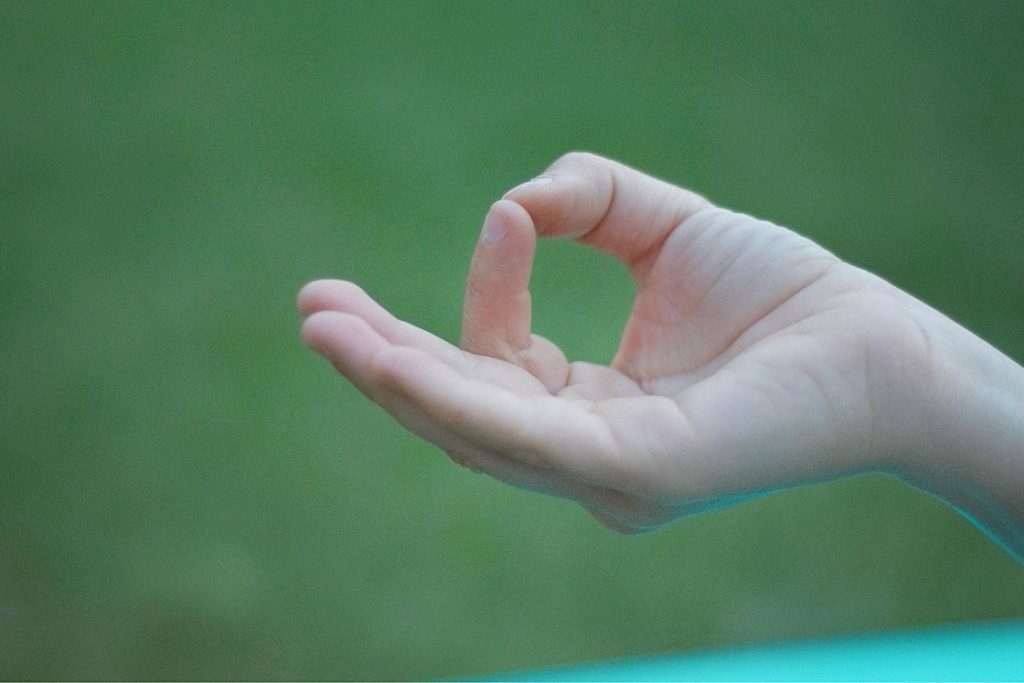
Gyan Mudra, also known as the Mudra of Knowledge, is a simple yogic hand gesture used in meditation to calm the mind and improve focus. It is formed by gently joining the tip of the index finger with the tip of the thumb. This gesture represents the union of individual consciousness with universal consciousness, symbolising wisdom rising above ignorance.
In yoga, mudras are specific hand positions that guide energy through the body. Gyan Mudra is one of the most widely practised mudras because it helps steady thoughts, supports mental clarity, and prepares the mind for deep meditation. Its simplicity makes it suitable for beginners and experienced practitioners alike.
Also Read: 59 Powerful Yoga Mudras Explained with Benefits
Contact of Index finger & thumb
The touching of the index finger and thumb in Gyan Mudra is a symbolic gesture of higher knowledge. This simple circle shows the union of the individual soul with the supreme soul, where wisdom rises and ignorance falls away.
In many spiritual traditions, this hand gesture is used to show the sharing of knowledge. The Vitarka Mudra, commonly seen in Buddhist statues, is closely related and represents the transmission of wisdom from teacher to student.

In the Mahabharata, it is said that Sri Krishna held his hand in Gyan Mudra while giving the teachings of the Bhagavad Gita to Arjuna. Arjuna was lost in confusion and doubt, and this gesture symbolised the guidance and clarity Krishna offered during the war.
How to do gyan mudra(step-by-step)
Gyan Mudra can be practised anywhere, at any time. Follow these simple steps:
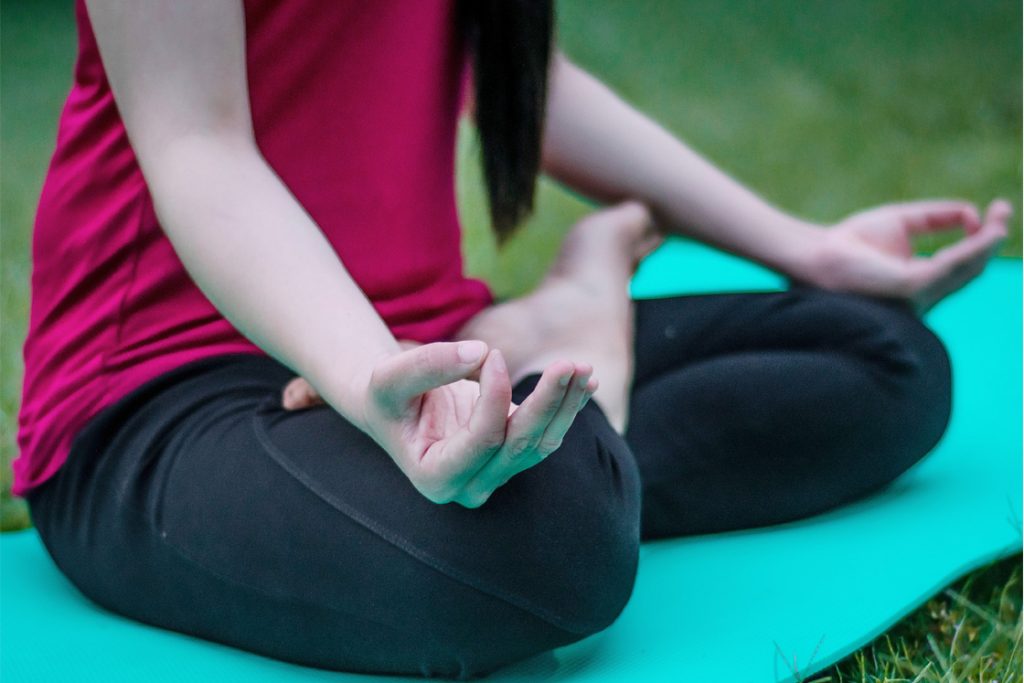
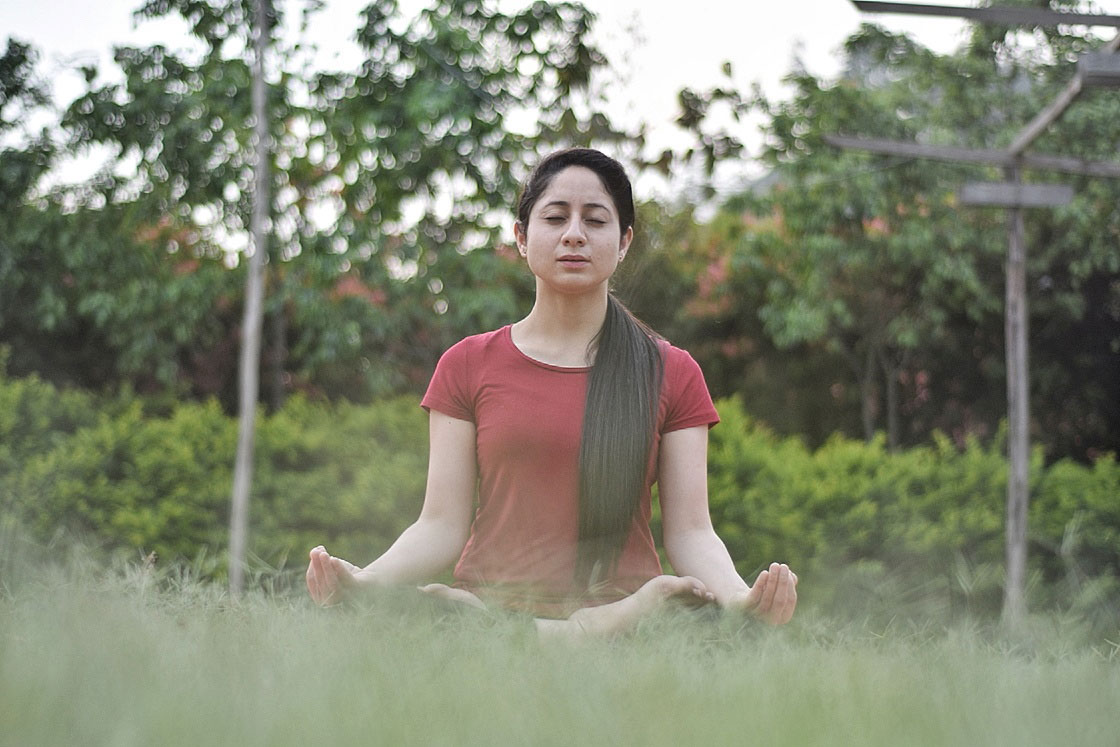
- Sit comfortably in a meditative posture like Padmasana or Sukhasana. You may also sit on a chair with your spine straight and shoulders relaxed.
- Rest your hands on your knees, palms facing upward. Gently stretch your fingers to release any tension.
- Relax your hand, then bring the tip of your index finger towards the tip of your thumb.
- Join both fingertips to form a soft, even circle. Keep the other three fingers relaxed or slightly extended.
- Close your eyes and bring your attention to your natural breath. Feel the air moving in and out of your nostrils.
- When the breath becomes steady, shift your awareness to the Third Eye centre (between the eyebrows).
Important alignment tip
Let the index finger move towards the thumb, not the thumb bending towards the index finger.
- The thumb symbolises universal consciousness.
- The index finger symbolises individual consciousness.
By allowing the index finger to approach the thumb, we symbolically surrender the individual self to the universal self.
Gyan Mudra is easy to practise and can be done while sitting comfortably in any meditative posture.
Variations of gyan mudra
- Jnana Mudra: Index finger touches the base (root) of the thumb; palms face upward on the knees.
- Chin Mudra: Same finger position as Jnana Mudra, but palms face downward.
- Purna Gyan Mudra: Both hands form Gyan Mudra; the left hand rests on the left knee while the right hand lifts in front of the chest.
- Gyan Vairagya Mudra: Hands rest on the thighs instead of the knees while holding Gyan Mudra.
Ideal time & duration for gyan mudra
To experience the full therapeutic effects of any mudra, it is recommended to practise the gesture for at least 45 minutes a day. You can do this in one session or break it into three sets of 15 minutes, which is easier for beginners.
Gyan Mudra is often more comfortable to hold during pranayama practices such as Kapalbhati, Ujjayi, or slow deep breathing, because the rhythm of the breath helps you maintain the hand position naturally.
The best time to practise Gyan Mudra is early morning, when the mind is fresh and quiet. Many practitioners also follow it with Prana Mudra for 15 minutes to support energy flow through the day.
Science behind gyan mudra
According to the Pancha Tattva theory, each finger represents one of the five elements—fire, air, ether, earth, and water. In Gyan Mudra, the index finger (air) touches the thumb (fire), bringing these two elements into harmony.
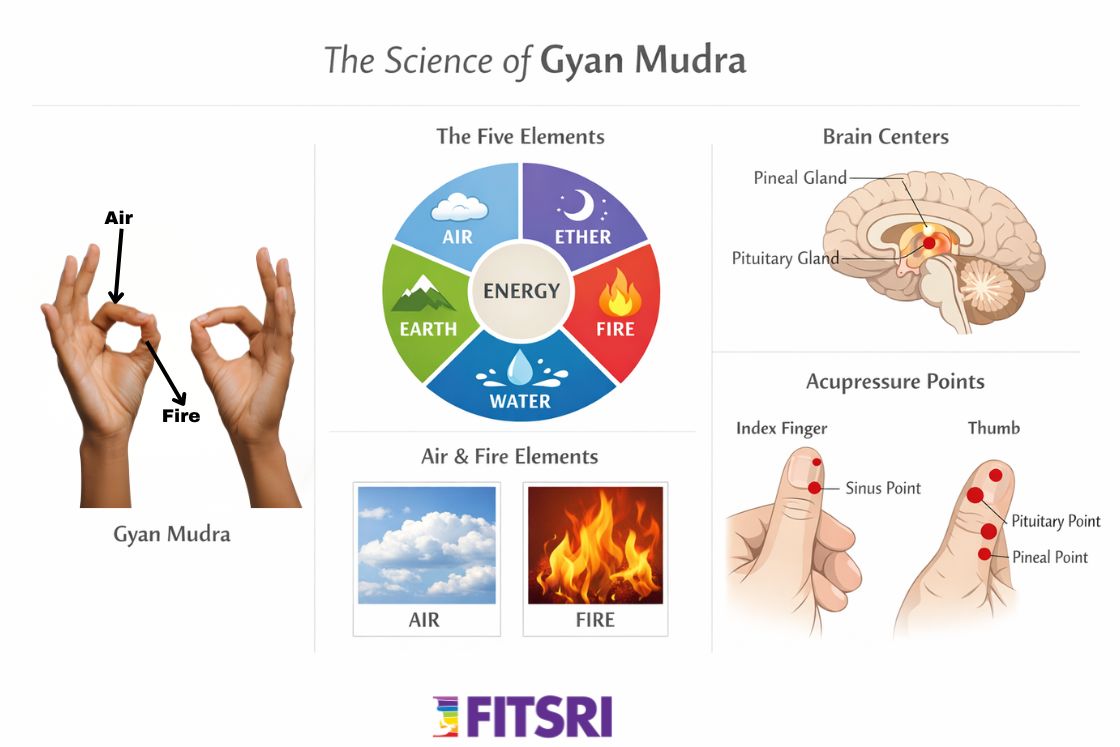
The air element controls the nervous system, thoughts, and mental movements. When we hold Gyan Mudra, the air element increases, which is why this gesture is also called Vaayu Vardhak Mudra. A balanced air element supports clearer thinking, better memory, and sharper attention.
The fire element in the thumb helps steady the air element. It brings warmth, stability, and direction to our thoughts. Together, air and fire create a calm yet active mental state-ideal for focus, study, meditation, and creative work.bination of fire and air elements causes a positive effect on our minds which leads to better focus.
Acupressure and brain activation
When the index finger presses lightly on the tip of the thumb, it stimulates acupressure points linked to:
- the pituitary gland (master gland of the endocrine system)
- the pineal gland (linked with intuition and inner awareness)
These glands help regulate hormones, sleep cycles, stress responses, and overall mental clarity. In yogic philosophy, the pineal gland is seen as a centre of higher awareness or “psychic” insight.
Through this gentle stimulation, Gyan Mudra supports calmness, clarity, and deeper states of meditation.
Side effects & precautions
- Gyan Mudra increases the air element in the body, so it may worsen gas, bloating, or weak digestion if you already experience these issues.
- Wear comfortable, loose clothing to avoid distraction during practice.
- If you have a Vata dosha imbalance, practise this mudra in moderation because Vata already has a high air element.
- Avoid doing this mudra immediately after heavy meals if it increases bloating or discomfort.
- Reduce the duration if you feel dryness, restlessness, or digestive discomfort.
- Stop or shorten the practice if you notice any unusual sensations in the body.
Gyan Mudra Benefits
Gyan Mudra is widely used because it supports both mental ease and energetic balance. These benefits come from traditional yogic understanding and research on yoga mudras and mind-body practices.
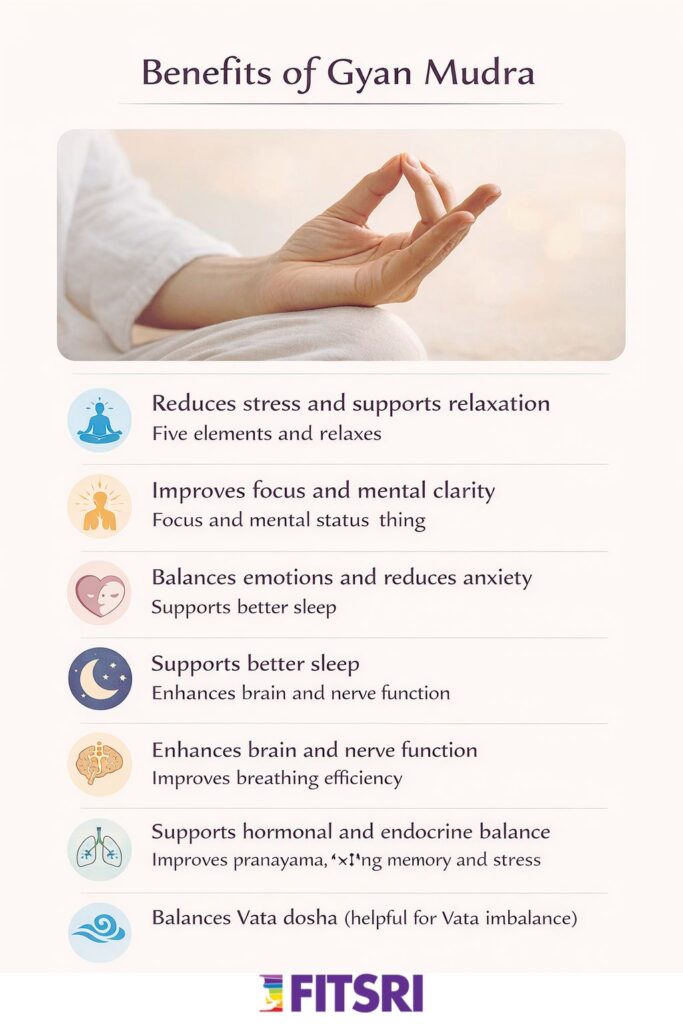
1. Reduces stress and supports relaxation: Gyan Mudra encourages slow, steady breathing, which activates the parasympathetic (rest-and-digest) response. This naturally reduces stress and helps the body settle into a calmer state.
2. Improves focus and mental clarity: Gyan Mudra helps the mind settle and improves attention. Research on yoga and hand practices shows positive effects on memory and cognitive performance.
3. Helps balance emotions and ease anxiety: Regular practice can steady emotional fluctuations. Mind-body techniques, especially those involving breath and hand gestures, are linked to reduced anxiety and greater emotional stability.
4. Supports better sleep: Gyan Mudra is often used before bedtime to ease mental clutter. Relaxation practices similar to mudras have shown positive effects on insomnia and overall sleep quality.
5. Enhances brain and nerve function: The gentle pressure between fingertips stimulates nerve endings that connect with brain pathways. Research on hand-based yogic practices shows benefits for motor control and cognitive health.
6. Helps improve breathing efficiency: Gyan Mudra is commonly paired with pranayama. Yogic breathing practices are shown to improve lung capacity, respiratory ease, and oxygen flow.
7. Supports hormonal and endocrine balance: Yogic texts link this mudra to the pituitary and pineal glands. Modern research shows that relaxation and meditation techniques help stabilise hormone levels and reduce cortisol, supporting overall endocrine health.
8. Gyan Mudra for Balancing Vata Dosha: According to Ayurveda, Gyan Mudra increases the air element in the body, which can help people with Vata deficiency by restoring clarity, stability, and mental energy. While this benefit comes from traditional Ayurvedic knowledge, it aligns with yoga research showing mudras influence physiological and energetic balance.
Conclusion
Gyan Mudra is one of the simplest and most powerful hand gestures in yoga. By joining the index finger and thumb, it helps steady the mind, direct energy smoothly through the body, and create a state of calm awareness. Whether you use it for meditation, pranayama, or daily grounding, this mudra supports clearer thinking, balanced emotions, and a more relaxed nervous system.
Both traditional teachings and growing research show that mudras can influence physiological and mental functions, making Gyan Mudra a supportive tool for stress relief, focus, sleep, breathing, and overall well-being. Its gentle nature also makes it accessible for beginners, yet deeply effective for experienced practitioners.
Practise it each day, even for a few minutes, and let the simplicity of this gesture guide you towards a quieter mind, steadier breath, and a deeper sense of inner clarity.





I wonder if this information is in book form anywhere? Very good explanations!
Hi, I saw your website this is very useful to everyone about yoga asana’s, Thanks to you, is there any way to get a Height increase using yoga asana, right now I am 25 years if possible please let me know
Yes, you can check out this article on “Yoga for height increase.“
hi Ashish,
Namaskar!
Is there any Mudra to control the B.P. and to get rid of taking tablets gradually.
Yes, these three mudras will keep B.P in control: Vyana Mudra, Akash Mudra, and Apana Vayu Mudra .
Vyana Mudra – Join the tip of the index and middle finger to the thumb tip – rest two fingers extended straight.
Hi Hemant/Ashish
I am seeing that Gyan Mudra and Chin Mudra are interchanged or meant to be same according to this article.
The similarity in both cases the Index finger and Thumb touch the tip. In Gyan Mudra palm is facing up and used while meditating. In Chin Mudra palm is facing down and is used during Pranayama. Am I mistaken? Thanks.
You’re right about the difference in the chin and Gyan mudra. But as the formation of chin mudra is similar to Gyan mudra, sometimes it’s called as its synonym mudra, though, for a deeper understanding, you clearly mentioned its difference. Thank you 🙂
Hi Hemanth and Ashish, very well explained article. I have a question. The air element stimulates the nervous system and that helps the brain is what I understood from the article. But what happens to the fire element?
Hey Srini, the fire element is complementary in Gyan Mudra to enhance the power of the air element, yet it’s important in another way. In fact, this is the key point in all mudras; one strong element combines with others to complement it or to balance the minor one.
Understand the fire element in Gyan mudra like this; what happens when you combine air and fire, the fire becomes sharper, right? The deeper your meditation practice is, the sharper will become the fire element. While doing Gyan mudra, this is the radiance of the fire element itself that visible to us as a positive aura around enlightened yogis.
Very well explained. Thank you so much Ashish. Appreciate the help.
I read the article with great interest. In some places, you have mentioned the Mudra balances Air element; in some places, you say the Mudra increased Vayu. Which one is correct? Pl guide.
Both statements are correct. By means of saying Gyan mudra balances air element, it includes both – The excess of air element will be reduced down to the normal level and if there is a deficiency in the air element, it will also fulfill its deficiency.
Master Sayings
Hi Hemant,
I would like to practice this mudra because I have lost a lot concentration, but I have gas problems abd bloating, Is there a way to practice it a little bit?
Thanks,
AnaLu
In your case, first, do a few rounds of Wind-Relieving Pose (Pawanmuktasana) then sit in a cross-legged posture for Gyan mudra. This way you won’t face any problem and can do Gyan mudra without any physical disturbance.
Is there any “Mudra or yoga therapy” for allergically sneezing, which is chronic for patient?
Yes, there are many yoga practices which can help chronic patient relief the symptoms to allergic sneezing. The best mudra for this is Bhramara Mudra and Shankha Mudra. We will email you a detailed article on mudra therapy for allergic sneezing once we prepare it.
Sir how many days we can achieve a good result? actually, I have mentally weak how many days need to get wisdom from this mudra
The way it’s described around chakras, it becomes easier to understand that logic. Thanks for the explanation.
Is there any logic behind circular shape that formed by thumb & index finger in gyan mudra? I heard from a yoga teacher, this circular shape represents motion of prana in our body but didn’t understand what exactly it means.
There are two things you must know about prana: Prana is the root source of all energy manifests in & out of the body & mind. In the yogic tradition, the energy that generates via some means within the body always moves in a circular motion. For example chakras
Now come to Gyan mudra. The circular shape formed in Gyan mudra denotes we are giving our prana a path to move in a circular motion, within the body rather than dissipating it in the outer world.
And in another way, we can relate this circular shape with a long-lasting connection between our individual soul (represents by index finger) & universal soul (represents by thumb).