If you have ever practised Yoga Nidra, you have probably heard the teacher say at some point:
“Now plant your sankalpa.”
If you are new to the practice, you may have nodded along without being entirely sure what that means – or why it matters so much.
In Yoga Nidra, sankalpa is often translated as intention, resolve, or heartfelt wish. But in Yoga Nidra, it is something more specific and more powerful than simply setting a goal or repeating a positive thought.
Yoga Nidra works with the deeper layers of the mind. When the body is deeply relaxed and the mind becomes quiet, it becomes possible to plant a clear inner resolve at a level deeper than ordinary thinking. This resolve is called sankalpa.
In this article, we will explore what sankalpa really means in the yogic tradition, why it is placed at specific points in the Yoga Nidra practice, how it gradually influences the mind, and how you can choose a sankalpa that is genuine and meaningful for your own life.
In Yoga Nidra, the sankalpa plays a central role in guiding the deeper direction of the practice.
What is sankalpa in yoga nidra?
The Sanskrit word sankalpa is made of two parts.
- San refers to truth or deeper awareness.
- Kalpa means a vow, commitment, or firm resolve.
Together, sankalpa means a clear inner resolve that arises from your deeper truth.
This is different from a typical resolution or affirmation. A resolution often relies on willpower. An affirmation is usually repeated to encourage positive thinking.
Sankalpa works differently.
Instead of trying to change the mind through effort, it is planted gently in a quiet and receptive state of awareness. Over time, this resolve begins to influence deeper patterns of thought and behaviour.
In this sense, sankalpa is not about forcing change. It is about aligning your inner direction with what you truly wish to cultivate in your life.
Join Our 6-day Live Yoga Nidra Workshop
Why sankalpa is important in yoga nidra
Yoga Nidra is often described as “yogic sleep,” but it is more than deep relaxation.
The practice guides awareness through several layers of the body and mind. As the practice unfolds, tension softens, the senses withdraw inward, and the thinking mind becomes quieter.
This creates a rare moment when the mind is both relaxed and aware.
In this state, the mind becomes more open to suggestion and inner direction. The sankalpa is introduced at this moment because it can then reach deeper levels of the mind where habits and impressions are stored.
Without sankalpa, Yoga Nidra is still deeply restorative. But the sankalpa adds a personal direction to the practice, allowing it to support inner change as well as relaxation.
Sankalpa as a seed
Traditional teaching often describes sankalpa as a seed planted in the soil of the mind.
Like a seed, it is not forced into growth. It is simply planted under the right conditions.
Each time you repeat the same sankalpa during Yoga Nidra, you are gently watering that seed. Over time, the quality expressed in the sankalpa begins to grow naturally in your life.
Because of this, sankalpa is not something that changes frequently. Most practitioners stay with the same resolve for many months, sometimes longer, until they feel it has genuinely taken root. This distinction matters, and it will come up again when we talk about common mistakes.
Where sankalpa appears in the structure of yoga nidra
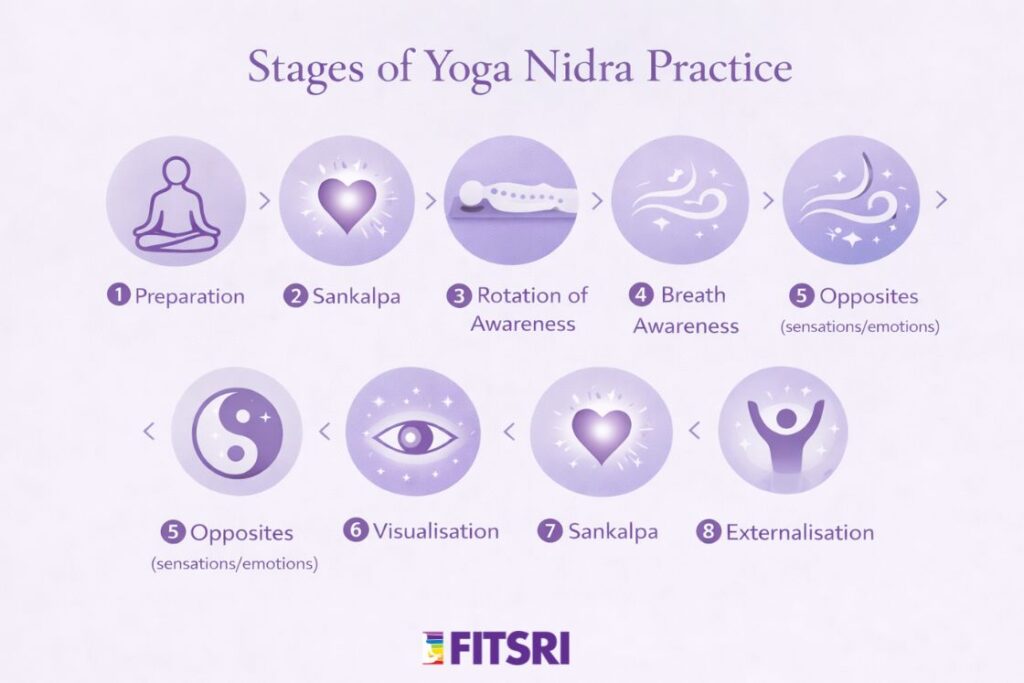
To understand why sankalpa is effective, it helps to see where it appears in the traditional structure of Yoga Nidra.
A classical Yoga Nidra session often follows this sequence:
- Preparation – settling the body and becoming comfortable
- Sankalpa – first planting of the resolve
- Rotation of awareness – moving attention through the body
- Breath awareness
- Pairs of opposites – exploring contrasting sensations and emotions
- Visualisation
- Sankalpa – repeating the resolve again
- Externalisation – gradually returning to waking awareness
The sankalpa appears twice in the practice.
The first time is near the beginning, when the body has relaxed and the mind has become calm.
The second time is near the end of the practice, when the mind has passed through deeper stages of relaxation and is especially receptive.
Repeating the sankalpa at these two moments helps reinforce the impression at deeper levels of awareness.
Also Read: Yoga Nidra Stages and It’s Benefits
Why this order matters
The sequence is deliberate. The first planting sets a direction — like giving a quiet instruction to the mind before it goes deeper. The second planting consolidates what the whole practice has prepared. Between the two, the practice itself loosens the deeper layers of habit, resistance, and old impression, making the mind genuinely ready to receive.
This structure was not created recently. It reflects a long tradition of observing how the mind works- not only at the surface, but at deeper levels of awareness.
How sankalpa works during yoga nidra
You could repeat your sankalpa any time in the morning, before sleep, during a quiet moment. And there is value in that. But Yoga Nidra creates conditions that are qualitatively different, and understanding this changes how you relate to the practice.
The deeper layers of mind
Yoga philosophy describes human experience as consisting of several layers, known as koshas. These include the physical body, the breath and energy layer, the mind and emotions, deeper awareness, and a state of deep inner stillness.
When you are in ordinary waking life, the outer layers are dominant. The analytical mind is busy, the body is engaged, and the senses are active. In this state, a sankalpa tends to remain at the surface. The mind processes it like any other thought assessing it, doubting it, sometimes accepting it, sometimes pushing it away.
The threshold state
Yoga Nidra guides you to a state between waking and sleep. In this state, the body is completely at rest, the senses have withdrawn inward, and the ordinary analytical activity of the mind has quietened significantly. The deeper layers of mind become accessible.
In modern psychology this state is often called the hypnagogic state the natural borderland between waking and sleep. In yogic language, it is the space where chitta (the mind-stuff) becomes still and highly impressionable. A samskara a mental impression can be formed much more readily at this depth than in ordinary waking awareness.
When the sankalpa is planted here, it is not going through the same filtering and resistance it would in daily life. It is being placed directly into ground that is ready to receive it.
Sankalpa and Samskara
The word samskara is important here. In yogic understanding, the mind holds countless samskaras deep grooves or impressions formed by past experience, habit, and repeated thought. These samskaras shape how we perceive, how we react, and what we believe about ourselves, often without our conscious awareness.
Some samskaras are supportive. Others create patterns of fear, self-doubt, reactivity, or limitation that persist even when we consciously want to change. Yoga Nidra, through its systematic work on all the layers, creates conditions where old samskaras can be loosened. The sankalpa then plants a new and positive samskara in their place.
This is how change happens through sankalpa in Yoga Nidra. It is not based on willpower or positive thinking. Instead, it gradually creates a new pattern in the deeper layers of the mind.
How to choose your sankalpa
Choosing a sankalpa does not need to be complicated. The most effective sankalpa is usually simple and sincere.
A helpful way to choose one is to sit quietly for a few minutes and reflect on a simple question:
What quality would bring more balance or truth into my life right now?
Once you sense the direction, express it as a short positive statement.
Step-by-step guidelines
- Keep it short. One sentence, ideally. A few words if possible.
- State it in the present tense. Not “I will be” but “I am.”
- Make it positive. Say what you are moving toward, not what you want to leave behind.
- Point toward an inner quality. Not an external outcome or achievement.
- Let it be genuine. Choose something that genuinely moves you, not something you think sounds right.
- One at a time. Work with a single sankalpa consistently not a different one each session.
Simple sankalpa examples for yoga nidra
A sankalpa usually describes an inner quality, rather than an external goal.
For inner peace
- I am calm and steady.
- I am at peace with myself.
- I move through life with ease.
For confidence
- I trust myself.
- I move through life with confidence.
- I am clear and capable.
For healing and stability
- My body is healthy and balanced.
- I am safe and supported.
- I am grounded and steady.
The exact words matter less than the sincerity behind them.
What you may experience when planting your sankalpa
Practitioners report a wide range of experiences when the sankalpa moment arrives. All of them are valid.
- Very little, especially at first
Many beginners report feeling almost nothing at first. They repeat the words internally and the practice moves on. This is completely fine. The effect of sankalpa does not depend on a particular feeling or inner experience. Trust the practice and continue showing up with the same resolve.
- A sense of settling or quiet recognition
With regular practice, many people begin to notice something subtle — a quiet sense of the words landing somewhere deeper than ordinary thought. Some describe it as a slight stillness or a sense of recognition, as if something inside simply says: yes. This is a sign the practice is taking hold.
- Emotion
Sometimes a sankalpa touches something real and tender. Tears may arise, or a feeling of relief, or a gentle opening in the chest. This is not a problem- it is often a sign that the sankalpa is connecting with something genuine. Simply let the feeling be there and continue.
- Forgetting or distraction
It is common, especially early on, to reach the sankalpa moment and find the mind has wandered — or that you have forgotten your exact wording. Simply return, state it as clearly as you can, and move on. No frustration needed. Consistency over time matters far more than perfect execution in any single session.
The effects of working with sankalpa over time
The classical tradition is clear that the effects of sankalpa in Yoga Nidra are gradual and cumulative. They are not about dramatic transformation in a single session. They come from sincere, regular practice over weeks and months.
- Inner alignment
Over time, there is a gradual closing of the gap between what you know to be true about yourself and how you actually feel and behave. Patterns of self-contradiction, self-doubt, or inner conflict quietly begin to soften. This is not a forced change- it happens organically as the samskara deepens.
- Change without struggle
One of the most commonly reported and most striking effects is that the quality being cultivated through sankalpa begins to appear in daily life without effort. You do not notice yourself trying to be calmer — you simply find you are. The shift comes from the inside, not from pushing yourself.
- Greater sense of purpose and direction
Returning again and again to the same deep resolve has a grounding effect. Even if life is busy or unsettled, there is a quiet thread of direction running beneath it. Many practitioners describe a growing sense of knowing what genuinely matters to them.
- Strengthening of will
In yogic understanding, will is not about force. It is the capacity to move consistently in a direction that is aligned with your deepest nature. Working with sankalpa over time develops this capacity — not the brittle willpower that exhausts itself, but a steadier, quieter kind of resolve.
- The Sankalpa within the broader benefits of the practice
Yoga Nidra carries its own well-established effects on the nervous system, on the quality of rest, on stress, on mental clarity. The sankalpa does not replace or compete with these. It adds a personal, intentional dimension that gives the practice a specific direction tailored to where you most need to grow.
Who is this practice suitable for?
Working with sankalpa in Yoga Nidra is suitable for almost anyone who can follow spoken guidance in a state of relaxed awareness. Because the practice is done lying down and requires no physical exertion, it is accessible to people of all ages and physical conditions.
Beginners
Beginners can and should work with a sankalpa from their very first Yoga Nidra session. It does not need to be elaborate or profound. Something simple and genuinely felt is a perfect place to start.
People in periods of change or challenge
If you are moving through a significant life transition a health challenge, a loss, a change of direction — a carefully chosen sankalpa can serve as a quiet anchor. It does not need to solve anything. It simply keeps you oriented toward something true while the outer landscape shifts.
People who feel stuck
If you have been trying to change something in yourself through willpower and finding that the same patterns keep returning, sankalpa in Yoga Nidra offers a different entry point working at the level of samskara rather than trying to override the surface mind.
Experienced practitioners
For those already familiar with Yoga Nidra, revisiting the sankalpa with fresh sincerity rather than treating it as a routine moment in the practice — can significantly deepen the overall effect. Sometimes what is needed is not a new sankalpa but a more genuine relationship with the one already being worked with.
Tips for beginners
- Start simply. You do not need a perfect sankalpa to begin. Choose something honest and true for where you are right now. You can refine it over time.
- Write it down. Keeping your sankalpa written somewhere you see it helps maintain consistency across sessions and prevents the common problem of forgetting it mid-practice.
- Do not over-analyse it. Once you have chosen your sankalpa, commit to it. The analytical mind will always find reasons to question. Let it be and work with it.
- Give it time. Weeks, not days. Months for deeper change. Regular practice is far more valuable than intensity. Even a short session three times a week is much better than an occasional long one.
- Keep it private. Your sankalpa is a personal inner resolve. There is no need to explain or justify it to others. The tradition often suggests keeping it to yourself — this preserves its energy and prevents the mind from becoming distracted by others’ opinions.
- Trust even when you feel nothing. The absence of strong feeling during the sankalpa moment does not mean nothing is happening. The work is often quiet and subtle. Trust the structure of the practice.
Common mistakes to avoid
- Changing your sankalpa too often
This is the most common mistake, especially among practitioners who are engaged and enthusiastic. Changing your sankalpa each session or even each month — prevents the impression from forming properly. Commit to one and stay with it. If you genuinely sense it has taken root and a deeper one is calling, that is different. But restlessness is not the same as readiness.
- Choosing an external outcome
A sankalpa like “I will get the promotion” or “I will find a relationship” is working at the wrong level. These are external outcomes — things that depend on circumstances, other people, and factors outside your control. A sankalpa points to an inner quality: confidence, openness, clarity, ease, wholeness. Cultivate the inner quality, and the outer life follows in its own way and time. This is the direction of the teaching from inside out, not the reverse.
- Stating It as something you are trying to be
The sankalpa is stated as present truth, not future aspiration. “I am becoming calmer” is not the right form. “I am calm and steady” is. This is not self-deception — it is a deliberate instruction to the deeper mind about the direction of travel. The present tense carries a different quality of certainty than the future tense.
- Forcing an experience
The sankalpa moment should be quiet and inward. There is no need to feel something profound, to strain for intensity, or to hold the words with great effort. Simply place them in the mind gently and clearly, and let them settle. Effort at this point is counterproductive.
- Skipping the sankalpa
Some practitioners find the sankalpa instruction slightly awkward and quietly skip it, especially early on. Try not to. Even when it feels unfamiliar or clunky, placing the sankalpa is one of the most important moments in the practice. With repetition it will feel entirely natural.
Suitability and a note on care
Yoga Nidra is a gentle, non-physical practice and is broadly considered safe and supportive for most people. The sankalpa adds a psychological dimension that, for most practitioners, is deeply stabilising.
However, if you are currently working through significant psychological difficulty trauma, severe anxiety, dissociation, or a mental health condition requiring professional support — it is wise to approach the choice of sankalpa with care. Very emotionally charged sankalpas can sometimes open material that a person is not yet ready or supported to work with.
In these cases, a grounding and stabilising sankalpa is the better starting point. Something like “I am safe,” “I am supported,” or “I am grounded” can carry genuine power while remaining gentle in its effect. You can always deepen your sankalpa as your practice and your stability grow. If you are in any doubt, guidance from a qualified and experienced teacher is well worth seeking.
Conclusion
Yoga Nidra is one of the most complete practices offered by the yogic tradition.
Within this practice, sankalpa plays a special role. It is not simply a phrase repeated during relaxation. It is a quiet inner commitment placed in the mind when the mind is ready to receive it.
Through repeated practice, the sankalpa gradually becomes a new impression in the deeper layers of awareness. Old patterns soften, and new qualities begin to grow.
The change is rarely dramatic or immediate. Instead, it unfolds slowly and steadily over time.
Choose a sankalpa that feels genuine for you. Return to it regularly during practice. With patience and consistency, the seed you plant can gradually shape the direction of your inner life.
FAQs
A sankalpa and an affirmation may sound similar, but they are used differently. An affirmation is usually repeated during normal waking awareness to encourage positive thinking. A sankalpa, however, is introduced during Yoga Nidra when the mind is deeply relaxed and receptive. Because it is planted in this quiet state, it can reach deeper levels of the mind and gradually influence long-standing mental patterns.
It is generally recommended to stay with the same sankalpa for several months or longer. Repeating the same resolve consistently helps it take root in the deeper layers of the mind. Changing it too often may weaken its effect. However, if you genuinely feel that the intention has already manifested or no longer feels relevant, you can gently choose a new one.
Your sankalpa is usually repeated twice during each Yoga Nidra session — once near the beginning and once near the end of the practice. Outside of Yoga Nidra, you may also recall it quietly during moments of reflection, such as in the morning or before sleep.
Many practitioners use sankalpa to support changes in habits or emotional patterns. Because it works at the level of deeper mental impressions (samskaras), it can gradually influence behaviours that are difficult to change through willpower alone. However, the change usually happens slowly through regular practice rather than sudden transformation.
No. A goal usually focuses on achieving something in the external world, such as a career result or personal achievement. A sankalpa focuses on cultivating an inner quality, such as calmness, clarity, confidence, or compassion. When these inner qualities grow, external circumstances often shift naturally as well.
Yes. Beginners can start working with a sankalpa from their very first Yoga Nidra session. It does not need to be complex or deeply spiritual. A simple and sincere statement such as “I am calm and steady” or “I trust myself” is perfectly suitable for beginners.
Forgetting the exact words occasionally is completely normal, especially for beginners. If this happens, simply recall the general intention and repeat it as clearly as you can. Over time, the sankalpa becomes familiar and easier to remember.