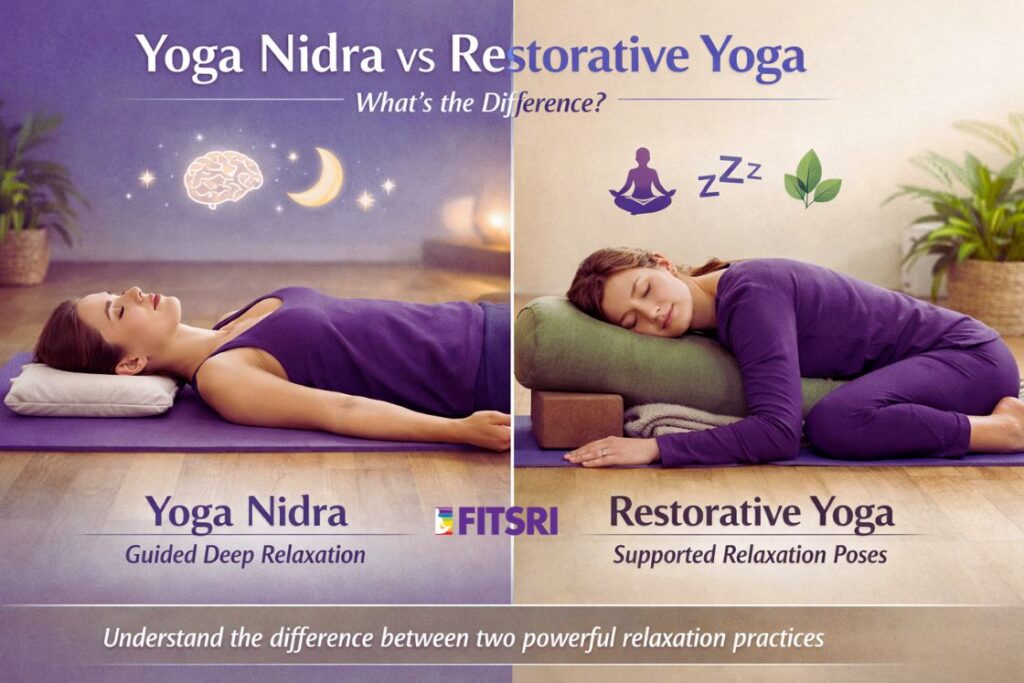
If you’ve ever looked at a yoga class schedule and noticed both Yoga Nidra and Restorative Yoga, you may wonder whether they are the same practice. Both involve slowing down, lying down, and relaxing deeply. Because of this, they are often grouped together as “rest-based yoga.”
However, the two practices are quite different in how they work and what they aim to do.
Yoga Nidra focuses mainly on guided inner awareness and mental relaxation, while Restorative Yoga works through supported physical postures that release tension in the body.
In this article, we’ll explore the difference between these two practices in simple terms how they work, what you might experience during a session, and how to decide which one may suit you best.
Key differences between yoga nidra and restorative yoga
| Aspect | Yoga Nidra | Restorative Yoga |
|---|---|---|
| Type of practice | Guided meditation practice | Passive yoga posture practice |
| Movement | No movement | Gentle supported poses |
| Main focus | Mental relaxation and awareness | Physical relaxation and tension release |
| Position | Mostly lying in Shavasana | Various supported postures |
| Props | Usually not required | Bolsters, blankets, blocks |
| Best for | Stress, anxiety, insomnia | Muscle tension, fatigue |
| Sleep during practice | Ideally stay aware | Falling asleep is common |
Both practices support deep relaxation, but they reach that state in different ways.
What is yoga nidra?
Yoga Nidra is often translated as “yogic sleep.” The phrase can be misleading, because the goal is not actually to sleep.
Instead, Yoga Nidra guides you into a state between waking and sleeping, where the body is deeply relaxed while the mind remains gently aware.
You lie comfortably in Shavasana (corpse pose) and follow the voice of a teacher or recording. Through guided instructions, awareness moves through different parts of the body and mind.
Many people describe Yoga Nidra as entering a quiet inner space where the body feels heavy, the breath slows, and thoughts become less active.
Join Our 6 Day live Yoga Nidra Workshop
How a yoga nidra session works
You lie flat on your back in shavasana the classic yoga relaxation pose and you stay there for the entire practice. No movement is required. The teacher (or a recording) guides you through a structured series of inner experiences using their voice.
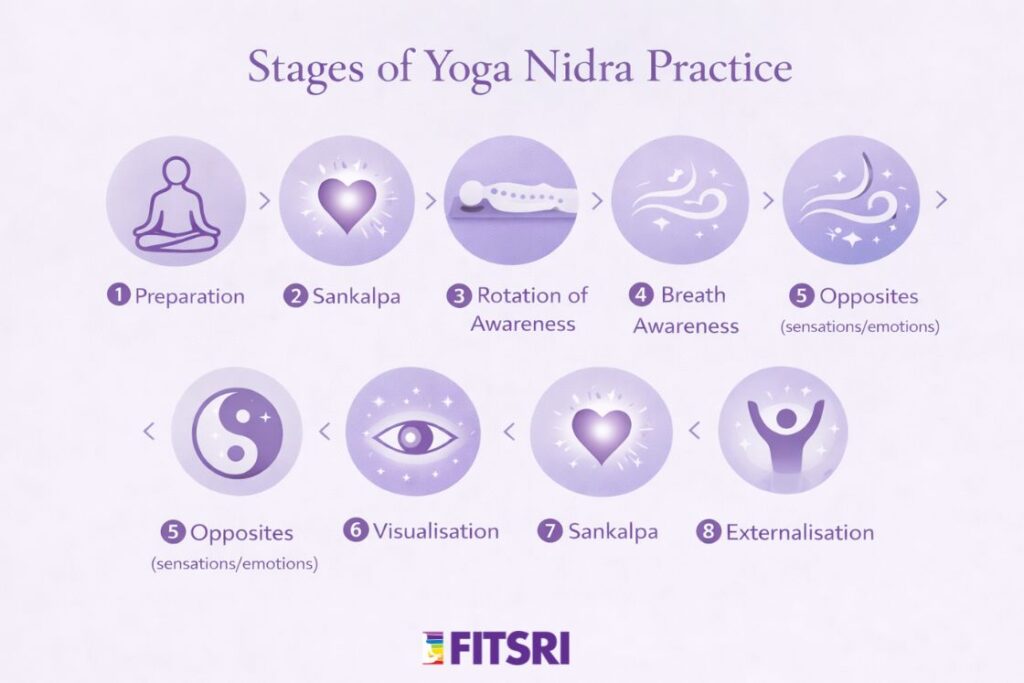
A classical yoga nidra session typically moves through these stages:
- Physical settling — getting comfortable and still
- Setting a sankalpa — a short, personal resolve or intention
- Rotation of consciousness — moving awareness systematically through different parts of the body
- Pairs of opposite sensations — like heaviness and lightness, warmth and cold
- Visualisation — inner images presented in rapid sequence
- Returning — gently bringing awareness back to the room
Each stage serves a specific purpose in taking the nervous system through a particular arc. The rotation of consciousness, for instance, uses the body’s neurological map to systematically disengage the mind from external stimulation. Yoga Nidra is not just about relaxing. It follows a structured process that gradually guides the mind into deeper states of rest and awareness.
Also Read: 8 Stages of Yoga Nidra
What you might experience
During yoga nidra, students often report a sense of the body becoming very heavy or almost disappearing. Some feel tingling. Some experience vivid images behind their eyes. Some feel waves of emotion come and go. Some feel nothing at all and simply feel deeply rested.
All of these experiences are normal. The practice meets you wherever you are.
One common beginner experience is drifting off to sleep, especially in the early stages. This is understandable most of us are running on a sleep debt, and the moment the body is invited to relax deeply, it seizes the opportunity. With practice, you learn to stay at that delicate edge of awareness.
What yoga nidra is not
It is not a guided meditation in the usual sense, though it uses the voice as a guide. It is not a visualisation exercise, though visualisation is part of it. It is not sleep, though it can feel like it. And it is certainly not a yoga posture practice no asana is involved at all.
It is its own distinct practice, with its own structure and its own effects on the mind and nervous system.
What is restorative yoga?
Restorative Yoga is a gentle physical practice that uses props to fully support the body in passive poses.
Props such as bolsters, blankets, blocks, and straps hold the body so that muscles do not need to work.
When the body is supported this way, tension can release gradually and naturally.
Restorative Yoga focuses primarily on physical relaxation and nervous system recovery.
How a Restorative Yoga Session Works
A typical restorative class includes only a few poses, often between four and six.
Each posture may be held for 5 to 20 minutes, allowing the body time to soften and release.
Teachers spend time helping students adjust props so that each pose feels comfortable and effortless.
Common restorative postures include:
- Supported Child’s Pose – chest resting on a bolster
- Supported Bridge Pose – hips supported by a block or bolster
- Legs Up the Wall – legs resting vertically against a wall
- Supported Fish Pose – chest opening over a bolster
- Supported Forward Fold – torso resting on a bolster
The goal is not stretching deeply but allowing the body to relax without effort.
What you might experience
Many students find the first few minutes of a restorative pose uncomfortable — not because anything is wrong, but because we are so unaccustomed to doing absolutely nothing. There can be a restlessness, a feeling of ‘I should be doing something.’
This usually settles within the first five minutes. Once the body understands it is safe to let go, the physical release that follows can feel quite profound.
Some people feel emotional release during restorative poses — particularly in poses that open the hips or the chest. This is not unusual. Stored tension in the body can carry an emotional quality, and when the physical holding releases, the emotional layer may follow.
Why props matter
Props are absolutely central to restorative yoga they are not optional extras. Without proper support, the muscles cannot fully release because they are still doing the work of holding the body in position. A well-propped restorative pose should feel like being gently held.
If you’re practicing at home and don’t have official yoga props, you can absolutely substitute:
- Firm sofa cushions or couch pillows for bolsters
- Folded blankets or duvets for height and support
- Hardback books stacked together for blocks
- A wall for legs-up-the-wall pose
The deeper difference: body vs. mind
Here is perhaps the clearest way to understand the distinction between the two practices:
Restorative yoga primarily works with the physical body. It uses the body’s relaxation response to release held tension in the muscles, the connective tissues, and the nervous system at a physical level. The mind can wander, drift, or even sleep — and the practice still does its job.
Yoga nidra primarily works with the mind. It uses a structured psychological process to move awareness through different layers of experience — the physical, the energetic, the emotional, and the deeper layers of the psyche. The body is simply the vehicle through which this inner journey happens.
That does not mean Yoga Nidra has no physical effects, or that Restorative Yoga does not influence the mind. Both practices affect the whole nervous system. Both practices influence the whole person. But the primary direction is different, and that matters when you are choosing what you need.
The science in simple terms
You don’t need to know the physiology in detail, but a basic understanding helps explain why these practices work.
The nervous system connection
Both practices activate the parasympathetic nervous system — sometimes called the ‘rest and digest’ mode — as opposed to the sympathetic ‘fight or flight’ mode that most of us spend too much time in. When the parasympathetic system is active, the heart rate slows, digestion improves, muscles release, and the stress hormones in the body begin to settle.
Restorative yoga activates this response primarily through physical stillness and supported postures. The body’s stretch receptors and pressure receptors send signals to the brain that say ‘we are safe, we can rest now.’
Yoga nidra activates this response through a combination of physical stillness and deliberate mental guidance. Research has shown that during yoga nidra, the brain can enter states similar to deep sleep — theta and delta brainwave activity — while the practitioner remains aware. This is quite unusual and is one reason why a 30-minute yoga nidra session is sometimes described as equivalent to several hours of ordinary sleep in terms of its restorative effect.
Note: This comparison is often made by practitioners and teachers based on reported experience and some early research. It should be understood as a general indicator of depth of rest, not a precise scientific claim. The quality of rest in yoga nidra is deep — that much is consistent across the research and the lived experience of practitioners.
Benefits: what can you realistically expect?
From regular yoga nidra practice
- Reduction in chronic stress and anxiety over time
- Improved sleep quality — particularly helpful for those with insomnia or racing thoughts at bedtime
- Greater emotional steadiness — less reactive in difficult situations
- A growing sense of inner spaciousness — the feeling that you are not identical with your thoughts
- Recovery from mental and emotional fatigue
- In longer-term practice, deeper self-understanding
These benefits tend to build gradually over weeks and months of regular practice. One session can be profoundly restful. Consistent practice is where the deeper shifts happen.
From regular restorative yoga practice
- Relief from chronic muscular tension — especially in the neck, shoulders, hips, and lower back
- Improved flexibility over time, through gentle passive opening
- Recovery support after injury or illness
- Relief from fatigue — particularly the heavy, body-tired kind
- Nervous system regulation, with a calmer baseline stress response
- Improved sleep when the physical tension that disrupts sleep is released
Restorative yoga is especially valued by people who are physically exhausted, recovering from illness, dealing with chronic pain, or simply carrying a great deal of physical tension in the body.
Who each practice may suit
Yoga Nidra is especially helpful for:
- People dealing with anxiety, stress, or an overactive mind
- Those who have trouble sleeping due to mental restlessness
- People who feel emotionally burnt out or depleted
- Those who want to go beyond the physical in their practice
- People who cannot do physical yoga due to injury or illness — yoga nidra is accessible to almost everyone
- Beginners who are curious about meditation but find sitting still difficult
Restorative Yoga is especially helpful for:
- People carrying a lot of physical tension — tight muscles, sore back, stiff hips
- Those recovering from physical illness, surgery, or injury
- Athletes or active people who need deep recovery
- People who feel physically exhausted — not just mentally tired
- Those new to yoga who want a gentle entry point
- Anyone who finds it hard to relax physically, even when the mind is quiet
Common beginner mistakes
In Yoga Nidra
- Trying too hard to have a particular experience the practice works best when you simply follow the instructions without expectation
- Giving up because they fell asleep – falling asleep occasionally is fine; it usually means the body needed it
- Treating it like a nap — the intention to stay aware, even if sleep comes, makes a difference
- Choosing music-heavy recordings as a substitute yoga nidra uses voice guidance through a specific structure; relaxation music alone is pleasant but is not yoga nidra
- Skipping the sankalpa — the personal resolve set at the beginning is an important part of the classical practice, not an optional extra
In Restorative Yoga
- Not using enough props — under-propped poses mean the muscles are still holding, which defeats the purpose
- Staying in a pose that is genuinely uncomfortable — mild unfamiliarity is fine; actual discomfort or pain is not
- Rushing through the transitions — moving quickly between poses loses the quality of stillness the practice builds
- Skipping the final shavasana — this integration period at the end is part of the practice
- Choosing a cold room — the body cools down during stillness; staying warm is important for the practice to work
Can beginners practice both?
Yes and many people find they complement each other beautifully. You might use restorative yoga on days when your body feels heavy and stiff, and yoga nidra on days when your mind is racing and you can’t settle. Some teachers combine elements of both in a single session, though the classical yoga nidra practice is usually offered on its own.
If you had to choose one to start with, a useful question to ask yourself is: where is the tension? If the answer is mostly in your body muscles, joints, physical fatigue start with restorative yoga. If the answer is mostly in your mind worry, restlessness, anxiety, emotional heaviness — start with yoga nidra.
How to start practicing
Starting yoga nidra
The most accessible way to begin yoga nidra is to find a good guided recording or attend a class led by an experienced teacher. Because the practice depends on the structure of the guidance, trying to practice it without instruction is difficult in the beginning.
Lie down in a comfortable position — on a yoga mat or your bed, with a pillow under your head if needed. Cover yourself with a light blanket. Remove distractions. Sessions typically run between 20 and 45 minutes. You do not need any prior yoga experience.
Beginner tip: If you find yourself falling asleep every time, try practicing at a time of day when you are not at your most tired. Sitting slightly upright against a wall (rather than lying completely flat) can also help you stay at the edge of awareness without tipping into sleep.
Starting Restorative Yoga
A class with an experienced teacher is ideal for beginners, because setting up the poses with the right support makes a significant difference. However, restorative yoga is also one of the more accessible home practices once you understand the basic poses.
Start with just one or two poses — legs up the wall is a beautiful starting point. Set a timer so you don’t have to check the clock. Gather whatever props or substitutes you have. Stay for five to ten minutes in each pose. Give yourself a few minutes of flat shavasana at the end.
Conclusion
Yoga Nidra and Restorative Yoga both offer something rare in modern life: deep rest. Yet they approach relaxation in different ways.
Restorative Yoga works through supported physical stillness, allowing the body to release tension. Yoga Nidra works through guided inner awareness, helping the mind settle into deep relaxation.
If your body feels tight or exhausted, restorative yoga may be the right place to start.
If your mind feels overwhelmed or restless, yoga nidra may offer the deeper relief.
Many practitioners eventually use both practices, choosing the one that suits their needs on a given day. Real rest does not come from distraction or entertainment. It comes from giving the body and mind the space to settle naturally. Both of these practices offer a gentle path toward that kind of rest.
FAQs
Yes, Yoga Nidra can be practiced using a guided audio recording once you understand the basic structure. However, beginners often benefit from learning the practice with a qualified teacher first, because the guidance and pacing of the instructions play an important role in the experience.
Both practices can be done several times a week or even daily. Yoga Nidra sessions are often practiced for 20–40 minutes, while restorative yoga can be practiced for shorter periods with one or two poses held for several minutes.
Yes, Yoga Nidra is often described as a guided meditation technique. However, unlike many traditional meditation practices that involve sitting and observing the breath, Yoga Nidra guides awareness through a structured process while the body remains lying down.
Restorative yoga can gradually improve flexibility because the supported poses allow muscles and connective tissues to relax deeply. Over time, this gentle release can help increase range of motion without forcing the body into intense stretches.
Both practices can be done at different times depending on your needs. Yoga Nidra is often practiced in the afternoon or evening to help reduce stress and improve sleep. Restorative yoga can be helpful at the end of the day, after exercise, or whenever the body feels tired and needs recovery.