
- Purpose
- Mechanism
- Effect
- ShankhaPrakshalana Asanas
- Procedure
- Contraindications
- Precautions
- Shankha Prakshalana Benefits
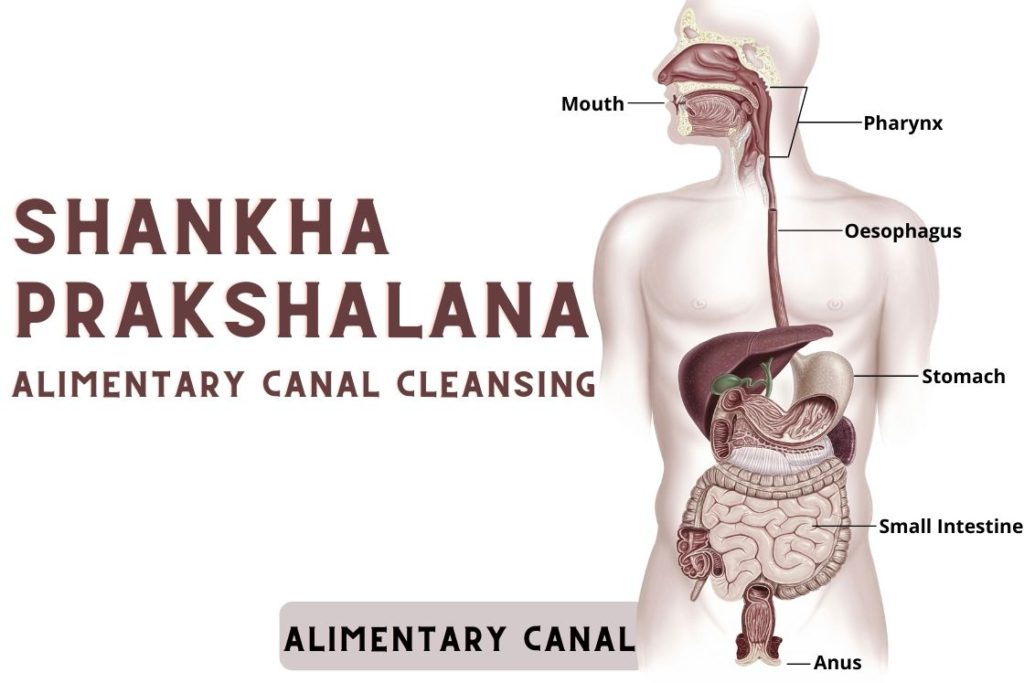
Shankha Prakshalana is a yogic cleansing kriya where lukewarm salt water is drunk in stages, followed by a set of five asanas to flush the entire digestive tract from the stomach to the anus. It is also known as Varisara Dhauti in classical Hatha Yoga texts.
Yoga describes the digestive system as shaped like a shankha (conch) because of its long, spiral-like intestines. The word Prakshalana means “cleansing”.
So, Shankha Prakshalana refers to cleansing the whole gastrointestinal tract from the mouth to the anus using warm saline water and movement.
Unlike other cleansing methods where water is vomited out, this kriya allows the water to pass naturally through the intestines. You drink warm salt water in small rounds and then perform a sequence of five movements called Shankha Prakshalana asanas. These asanas help guide the water through the digestive pathway.
The classical name, Varisara Dhauti, is made of three Sanskrit words:
- Vari – water
- Sara – essence or flow
- Dhauti – cleansing
The Gheranda Samhita describes Varisara Dhauti as a practice that removes toxins and brings clarity and lightness to the body.
What Shankha Prakshalana does
The main purpose of Shankha Prakshalana is to stimulate natural bowel movement without the use of medicines or harsh purgatives.
It helps the bowels clear smoothly by using warm salt water and gentle movement, reducing the chances of side effects.
This kriya is also an important part of the Ayurvedic rejuvenation method known as Kaya Kalpa.
Here, kaya means body and kalpa means transformation. So, the practice is seen as a way to physically renew and cleanse the body from within.
In this way, Shankha Prakshalana is not only a cleansing technique.
It is a holistic practice that removes internal impurities and supports both physical and mental wellbeing.
Mechanism of Shankha Prakshalana
Shankha Prakshalana begins by drinking about 250 ml of lukewarm saline water, followed by a specific sequence of five asanas:
- Tadasana
- Tiryaka Tadasana
- Katichakrasana
- Tiryaka Bhujangasana
- Udarakarshan

Each posture is done eight times to complete one full round. A practitioner usually performs 5–6 rounds, and the whole practice takes about one to one and a half hour
Why warm salt water is used
The water is kept at 38–40°C, which is gently warm. This temperature helps loosen old stool and mucus, making it easier for the bowels to release.
Salt is added so that the water does not get absorbed too quickly into the bloodstream.
This allows the water to stay inside the digestive tract and move through it smoothly until it exits through the anus.
How warm salt water works with the asanas
After drinking two glasses of water, you perform one round of the five asanas.
This movement helps guide the water from:
- the stomach,
- into the small intestine,
- through the large intestine,
- and finally out of the body.
This process washes away toxins, old waste, and mucus, leaving the digestive tract clean.
Physiological effects of Shankha Prakshalana
1. Promotes Peristalsis: The kriya washes the entire gastrointestinal tract from mouth to anus.
This stimulates natural peristalsis – the wave-like movement of the intestines which improves bowel movement and supports healthy digestion.
2. Helps Reduce Cholesterol (via Bile Removal): When peristalsis increases, food passes quickly from the stomach into the small intestine. Here it mixes with bile. Because the bowel movement is more active, bile is also removed more easily. Since cholesterol is used to produce bile, the body uses more cholesterol when bile is emptied regularly. This may help lower cholesterol levels naturally.
3. Improves Iron Absorption (Increases Haemoglobin): A thick layer of mucus in the intestines can block the absorption of iron. Shankha Prakshalana helps remove excess mucus, allowing the body to absorb iron more effectively. Better iron absorption supports healthy haemoglobin levels, improving overall vitality.
4. Activates the Parasympathetic Nervous System: Cleansing the digestive tract refreshes the internal organs and supports hormonal balance. When the body returns to balance, it naturally shifts into a calm, relaxed state, known as parasympathetic dominance.
This leads to:
- a sense of overall renewal
- a quieter mind
- better digestion
- reduced stress
Shankha Prakshalana asanas (sequence of five)
It involves five asanas in following order as described below:
1. Tadasana
- Stand separating the feet 15-18 inches.
- Bring your arms forward to the shoulder level and interlock the fingers.
- Extend them overhead with palms towards the ceiling.
- Lift the heels and stretch the body upwards as far as possible.
- Then release bringing the heels and hands down.
Tadasana opens the pyloric sphincter muscle that serves as a valve of the stomach opening to the small intestine. It streams the saline water into the small intestine along with chyme.
2. Tiryakatadasana
- Stand in tadasana with heels on the floor.
- Stretch upward and flex the waist towards left, be there for a while.
- Come back to the center and relax.
- Then bend towards the right and hold the pose.
- Again return to the center.
The bending involved in the asana contracts both sides of the coiled intestinal wall repeatedly. Thus, the water moves smoothly through the intestinal layer.
3. Katichakrasana
- Stand separating the legs 16-18 inches.
- Open the arms sideways to shoulder level with facing the floor.
- Rotate the upper body by the waist to the left.
- Bring your right hand around the body to be placed on the left shoulder bending the right elbow.
- Flexing the left elbow wrap the left arm around the twisted back towards the right placing the hand on the waist.
- Finally, turn the neck towards the left twisting the entire body to the left.
- Release and repeat on the other side.
The twisting involved in the asana exerts pressure into the intestinal muscles. It causes the flow of water downwards.
4. Tirayaka bhujangasana
- Lie down in a prone position.
- Raise your head to bring chin to the floor.
- Bring your hands beside the chest and curl the toes to the floor.
- Pressing the palms to the ground lift the chin, chest, and abdomen.
- Bend your right elbow and turn to look at your left heel, keeping the left arm straight.
- Come back to the center and then relax on the floor.
- Repeat the same on the right side.
This asana opens the ileocecal sphincter muscle and saline water reaches the large intestine. Thereby, clearing the entire pathway till here.
5. Udarakarshan
- Keep the feet hip-width apart.
- Sit bending the knee with soles on the ground.
- Keep your hands on knees.
- Push the right knee with the hand to bring it near the left foot.
- Now, push the left knee towards the right.
- Shrinking the lower abdomen, turn to look towards the left shoulder.
- Be there for 5-10 breaths, inhale and come back to sitting pose.
- Exhale and repeat it pushing the left knee to the right foot.
This last pose is helpful in squeezing the large intestine, stimulating, and stretching the digestive organs. It creates contraction and relaxation in the alimentary canal.
Finally, the stagnant stool and mucous is eliminated as the bowel movement is evacuated from the gastrointestinal tract. No traces of residual particles or saline water remains in the alimentary canal.
Shankha Prakshalana step by step (procedure)
The process of Shankhaprakshalana can be categorised into 3 parts;
1. Pre-procedure – Salt Water Preparation
The lukewarm water is used to prepare the saline solution. The ratio of salt to the water remains 2 teaspoons salt in 1 liter of water. Prepare an adequate amount of saline solution, as it consumes about 16 glasses of water.
Also, prepare a special meal for post-procedure. This special meal is khichdi of rice and moong dal cooked together. Add turmeric and eliminate salt addition. Cook it using ghee at the end to prepare a semi-liquid meal.
Choose a place like a garden or a terrace where you are in contact with fresh air to perform shankha prakshalana. Ensure there is an approachable toilet nearby.
Morning hours are preferable for this practice around 6-7 am.
2. Cleansing procedure – bowel movement
Begin with drinking 2 glasses of saline water and immediately perform the above-mentioned set of 5 asanas, 8 times each to complete the first round. Drink another 2 glasses repeating all the asana, 8 times each.
Repeat it a third time and then go to the toilet to check whether there is any bowel movement or not. Be there for 1-2 minutes and do not exert pressure externally.
Come back to repeating the procedure of drinking water and resume the asanas. It is followed by again visiting the toilet. Continue the process for about 6 rounds.
Almost after third round the evacuation process begins. The first time is accompanied by solid stool, followed by a mixture of stool and water. The concentration of stool decreases progressively and finally clear water will pass out of the anus.
3. Post-procedure – eat & relax
After the evacuation of clear water, stop the process and lie down in shavasana. Relax the body for 45 minutes maintaining complete silence.
Following the resting period of 45 minutes, eat the khichdi on time. Eat a sufficient amount to refine the intestine to resume peristalsis. Rest after having the first meal, but avoid sleeping for 3 hours. Repeat the meal after about 6 hours of the first meal.
Avoid any physical and mental activity for the whole day and keep resting the following day as well. Do not repeat this technique more than twice a year.
Duration – The process of shankha prakshalana must be completed in a day as described above.
Alternatively, beginners can perform it by following the process consecutively for 6 days. Have the first round of saltwater and asanas on the first day, followed by evacuating bowels. On each passing day keep increasing one round to complete the course in 6 days.
Types of Shankhaprakshalasna
Based on the quantity of saline water, Shankha prakshalasna is two types;
1. Laghu shankha prakshalana
Laghu means less or short. Here laghu referred to the quantity of saline water and the proportion it cleanses. In Laghu shankha prakshalana, maximum of 6-8 cups of water are taken only and then asanas are performed for bowel movemnt.
This is a shorter technique for cleansing the alimentary canal. For this also lukewarm salty water is prepared.
- Begin with drinking 2 glasses of prepared solution.
- Perform the 5 asanas as that of shankha prakshalana respectively, eight times each.
- Drink 2 glasses of saline water and repeat the asanas eight times each.
- Repeat it one more time and then go to the toilet.
- Check whether the bowel movement has been initiated or not without pressurizing externally.
- If it has not been started it will eventually come on later.
This practice takes one hour. It is important to take rest post practice for half an hour before having any food or drink.
2. Poorna Shankaprakshalana
Poorna means full or complete. In Poorna Shankaprakshalana, one keeps drinking water and performing 5 asanas back to back until the water coming out anus is as clean as the water going in.
Who should avoid this practice
Avoid the kriya if you have:
- Heart disease or high blood pressure
- Weak kidneys
- Pregnancy
- Gastric or intestinal ulcers
- Severe back pain
- Recent abdominal surgery
Precautions
- Stop the kriya as soon as clear water begins to pass.
- Do not sleep immediately after the practice.
- Avoid liquids for 2 hours after the meal.
- Avoid spicy, oily, packaged or non-veg foods for one month.
- Avoid dairy, pickles, sweets, and sour fruits for at least a week.
- No alcohol, cigarettes, or drugs for a month after the kriya.
- Keep the body warm to avoid cold, headache, or nausea.
Benefits of shankha prakshalana
1. Improves natural bowel movement: Shankha Prakshalana has been shown to support regular bowel movement and improve overall bowel health when practised regularly, reducing discomfort associated with constipation. In a controlled study, participants practising the kriya weekly for four weeks reported significant improvement in bowel health scores without adverse effects.
2. Supports colon cleansing for medical procedures: Research comparing Shankha Prakshalana with standard bowel preparation solutions found that this yogic technique prepared the colon effectively for procedures like colonoscopy, with fewer side effects such as nausea or bloating. This suggests its potential as a natural and well-tolerated method to clear the bowel when guided correctly.
3. May help reduce digestive discomfort: Evidence from reviews of clinical studies has found that the technique may help manage symptoms of digestive irregularities such as constipation, IBS, and abdominal discomfort. These benefits are likely due to improved peristalsis and coordinated movement of the gastrointestinal tract.
4. Enhances appetite and digestive function: A pilot study indicated that regular practice of this cleansing kriya not only clears the digestive tract but also improves appetite levels in healthy adults. Better appetite often reflects improved digestive function and gut signalling.
5. Safe for mild use in hypertension (under guidance): Pilot research suggests that a milder version of the practice (Laghu Shankha Prakshalana) can be safely introduced in individuals with essential hypertension, potentially supporting measures that aid blood pressure management as part of a broader yoga lifestyle.
6. Cleanses the entire digestive tract: Unlike enemas or local colon cleanses, Shankha Prakshalana involves flushing the entire digestive system from the stomach through to the large intestine using warm saline water and movement. This thorough approach helps remove old faecal matter and mucus that may otherwise remain deeper in the intestinal folds.
7. Promotes lightness and mental well-being: Although more research is needed, many practitioners and observational reports describe a sense of lightness and physical comfort after the practice, likely due to the removal of stagnant waste and improvement in gut motility. Traditional yoga texts support this as a preparatory kriya for deeper meditation and calm.
FAQs Shankha Prakshalana
1. What is the best time of day to practise Shankha Prakshalana?
The best time is early morning on an empty stomach, ideally between 6–7 am. This is when digestion is calm, the intestines are empty, and the body responds well to cleansing.
2. Do I need to fast before practising Shankha Prakshalana?
Yes. You should practise the kriya only after a light dinner the previous night and with no food in the morning. A clear stomach helps the saltwater move smoothly through the digestive tract.
3. What if the water does not come out during the practice?
If water does not pass out after the first few rounds, repeat the asanas slowly without forcing the bowels. Most people start eliminating after the third round. If there is still no movement, stop the practice and rest.
4. Can I drink plain water instead of salt water?
No. Plain water gets absorbed quickly by the intestines and does not cleanse the digestive tract. Saltwater stays inside the gut and supports the full washing effect.
5. How should I prepare my body before doing Shankha Prakshalana?
For 2–3 days before the practice, avoid heavy, fried, or spicy foods. Eating simple meals helps reduce mucus and prepares the intestines for cleansing. Light yoga or walking also helps.
6. Can I do other yoga practices on the same day?
Avoid all strong yoga practices on the day of Shankha Prakshalana. Instead, rest, stay warm, and allow your digestive system to recover. Gentle breathing or meditation is fine in the evening.
7. How long should I follow the special diet after the kriya?
Follow the simple diet of khichdi, ghee, and soft foods for at least one day. Avoid spicy, oily, sour, or processed foods for a minimum of one week to protect the cleansed digestive lining.


![What Is Yoga? Meaning, Philosophy, History, and Benefits Explained [With Infographics]](https://www.fitsri.com/wp-content/uploads/2018/07/what-is-yoga-brief-info-211x150.jpg "What Is Yoga? Meaning, Philosophy, History, and Benefits Explained [With Infographics]")



Hello dear teacher Ashish, can we do the fast just after the practice without eating.
That is to say do the kriya take a soup of ghee without salt and without solid to digest and start to just drink water
Hi Ashish Ji, I am doing 2nd round of Panchakarma and now in 2nd month at the moment doing day 5 ghee drinking after that I will have abhayanga and virechana ,is there any way I can do Lsp after virechana day or before Basti days ,as I have very bad lower back pain which not much improved after 1st month of punchakarma and I have hypothyroidism and I mtaking 45mg levothyroxine and in May I m going for ivf that is why don’t have much time to practice this,please let me know if I can do this along with panchkarma or not,I am 42years old female .thanks.
Hi!! Thank you for the article. I was wonder if you would reccomend this practice before starting a water fast? Would it be beneficial to perform the fast with empty bowels?
Thank you
Hi María! Thank you for your comment and interest in Shankha Prakshalana Kriya. It’s generally recommended to practice this cleansing technique on an empty stomach, and many individuals find it beneficial before starting a water fast. However, it’s important to listen to your body and consult with a healthcare professional, especially if you have any existing health conditions. Each person’s body responds differently, so it’s crucial to prioritize your well-being. If you have any specific concerns or medical considerations, it’s advisable to seek personalized advice. Wishing you a positive and mindful journey on your wellness path!
Thank you very much! I never received the notification of this response I believe.
I made this practice for the second time this year, about one week ago.
I did not perform the fast because I wanted to be more gentle with my body (and also started menstruating just the day of the practice).
Could you please tell me why is it that we can’t eat a non vegetarian diet for a month? I already started introducing egg today, and would like to introduce animal protein soon because I’ve been recognizing the benefits of a higher protein intake in the past 6 months.
Also, a pain in low low back pain in the right side lingered and I’m not sure if its because I performed the practice in the day my period came, or because I’d the salt water. It’s been 8 days already and it’s reduced but hasn’t disappeared. Any suggestions?
Thank you again 🙏
Thank you for this article 🙏
I did Shanka Praxalana yesterday as I’m doing it Normally but I haven’t go at all to toilet. Do you have any idea why? Thank you so much for your help
If you didn’t feel the need to use the toilet after performing Shankha Prakshalana kriya, it could be due to factors like hydration levels, the preparation of the saline solution, or your diet prior to the practice. Each body reacts differently to the kriya, and these factors can significantly influence its effectiveness. It’s important to ensure that you’re properly hydrated before performing the kriya, as dehydration can affect the effectiveness of the practice.
Typically it is expected to have the urge to use the toilet after performing Shankha Prakshalana kriya.
I am 42 years old . I did shankh orakshalan kriya yesterday , everything goes well that time but after that i got my periods early i.e. 5 days before. Usually my periods are late by late b6 3 to 10 days every month, means never ever it comes early. Beside this issue i am dlso feeling very week whole day yesterday and today even feeling not to do anything and having crapms on my finger joints
Is it normal ..also want to know i have thyrìod and did taking this much salt can cause any side effect?
Please help me
I appreciate you sharing your Shankha Prakshalana Kriya experience with us. It’s not unusual for menstrual cycles to fluctuate due to factors like stress or changes in diet and physical activity, which might explain your early period. The weakness and finger joint cramps you experienced could be linked to changes in electrolyte balance, hydration, or nutrition. Given your thyroid condition, it’s important to consider how the kriya’s dietary aspects, including salt intake, might impact your health.
The practice traditionally uses saltwater, which is meant to be mildly saline, similar to the salinity of tears. The idea is to make it isotonic with your body’s fluids, so it should not be too salty. Typically, a general guideline is to use about 2 teaspoons of salt per liter of water to achieve this mild salinity.
I recommend discussing these concerns with the instructor or practitioner who guided you through the process to address your specific situation more comprehensively.
I felt headache after doing SP…. please suggest some remedy for this
Experiencing a headache after Sankh Prakshalan could be due to factors like dehydration, electrolyte imbalances, blood pressure changes, and post-cleansing practices.
To address this, ensure adequate hydration before and after the practice, balance electrolytes through diet or supplements, and avoid sudden activities or immediate rest post-practice. If it still persists, consult an experienced practitioners or healthcare professionals for personalized guidance, considering individual variations in response.
Can I started yoga asana after performing laghoo shankhaprakshana.if not when I can perform asana practice. If I am facing constipation
It’s generally suggested to rest after Laghoo Shankhaprakshalana. This procedure itself includes 5 asanas that we do regulate bowel movement. After completing the procedure as mentioned in the above post, we eat khichdi and rest.
I am wondering is this can safely be done on the 5th day of a water fast? That will be tomorrow for me. Also, I have only red lentils in my kitchen now. Can the Khichdi be cooked using red lentils for digestibility?
Thanks!
It is not recommended to perform Shankha Prakshalana during water fasting as it involves drinking large amounts of water, which can be difficult on an empty stomach. It is better to wait until after breaking the fast to perform this practice. As for the Khichdi, red lentils can be used as a substitute for mung beans in the recipe for better digestibility.
Thanks for the great article, I did this. But, for me water came out as urine. Any thing I should have taken care?
Hi from UK
I did LP yesterday, one litre; some murky stuff came out, mostly water. Today I did it again with over 2L, but only some smaller amount of liquid came out and that’s it.
Now it is 6-7 hours later, still nothing happens. I feel ok, just some strange sounds from my belly occasionally. Yesterday had only one cup of spiced milk at evening and nothing else, day before a bit sup and piece of bread, and today few hours after LP some fruit and socked nuts. I’m not sure should I eat or not, because it may block me further. I have problems for the last month in bowel movement. I took some strong natural laxatives few times during this time, but now they don’t work.
Should I continue doing LP, as I was planning to do for one week, or until it gets better?
Thanks
It seems totally okay. When you do LP in a row, the liquid that comes out will not have that much content as compared to when you do it the first time.
After LP, it’s preferred to take Khichdi (rice and lentil porridge) as it’s a wholesome dish that fuels the body; especially the abdominal organs. You can search the recipe online. Fruits are still fine but don’t take socked nuts meanwhile. If you’re not feeling any complications, you can continue it for one week and see the changes.
What often we should perform laghu n dirgha shankha prakshalan
Laghu Shankha Prakshalana can be often practiced.
This article tells you that you should use 2 tablespoons of salt for one liter of water. This means 30 grams of salt per liter. This is far too much salt, and it should actually be 2 TEASPOONS of salt per liter of water, which is around 8.5 grams. I did this yesterday, and drank 60 grams of salt in 2 liters of water. I became very dehydrated and nauseous. I still had the cleansing process, but this is far too much salt. You guys need to change it in your article so it says 2 TEASPOONS, as drinking 60 grams of salt in such a short period of time is not good for the body. Please change this so others don’t make the same mistake that I did.
Oh, that’s a silly mistake, now it’s corrected. Thanks for informing about it, Austin, we appreciate your feedback!
I am a female aged 65 years. I practiced this and did not get any bowel movement after 7 rounds of the exercises. During the exercise rounds I did four repetitions of the exercises after drinking two glass of water after every round. I ate the prescribed meal post the exercise. I am not sure what to do next. When should I attempt it again. I did not have any problems during or after the exercises. I will be grateful if you could please help. Thanks
It’s a common thing with shankha prakshalan kriya that when you begin its practice, in the first 3 to 4 days, bowel movement doesn’t happen automatically after following the practice. Keep doing the kriya consecutively for one week and you will start showing the desired results.