Yoga Nidra cannot replace sleep, but it provides a different kind of deep rest that supports recovery and mental balance.
The question that comes up almost every time someone discovers yoga nidra is this:
“Can it replace sleep?”
The short answer is no. But that’s also the wrong question.
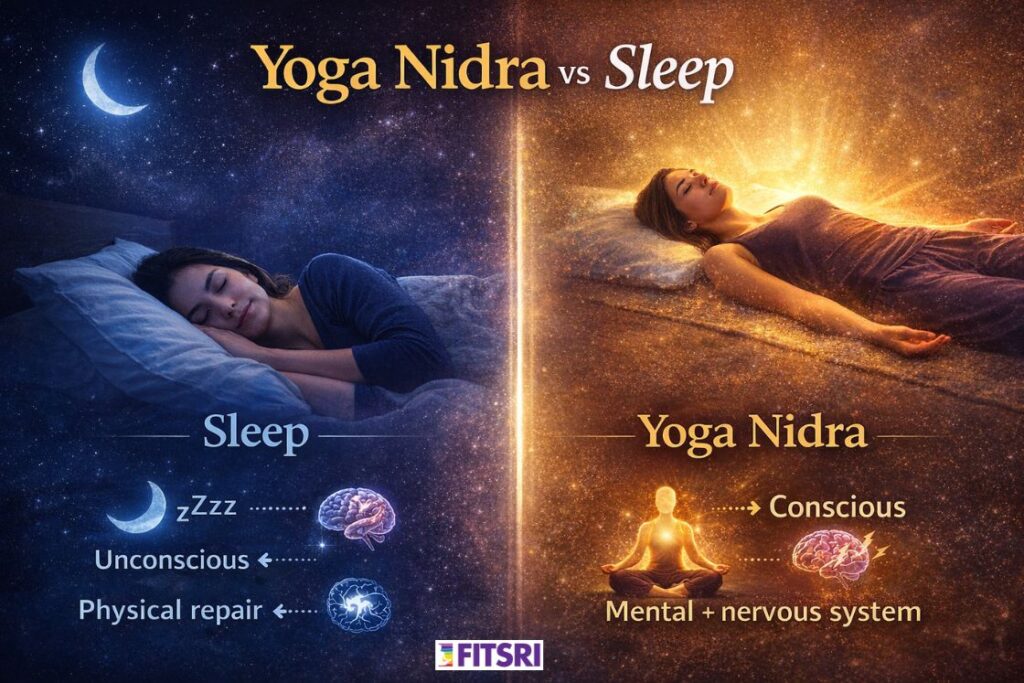
In yoga nidra, the body rests while awareness remains. In sleep, awareness is lost.
Once you understand this, yoga nidra becomes a far more powerful tool than most people in the West are currently using it as.
Yoga nidra and sleep are not competing with each other. They do completely different jobs. Asking which one is better for rest is like asking whether eating or drinking is more important — you need both.
Sleep restores the body through unconscious biological processes. Yoga nidra works differently. It brings you into a state of conscious rest, where the nervous system settles and deeper layers of tension can begin to release.
That said, there are real, measurable things yoga nidra does that sleep simply cannot. And if you have been relying on sleep alone to recover from stress, overtraining, burnout, or months of running on empty you may be missing a deeper level of restoration.
Also Read: 8 Stages of Yoga Nidra
The claim you’ve probably heard
If you found yoga nidra through a podcast or something Andrew Huberman said about NSDR (Non-Sleep Deep Rest) — you’re not alone.
NSDR is essentially a neuroscience-based reframing of yoga nidra for a Western audience. It has introduced a huge number of people to this practice for the first time, and that’s genuinely valuable.
Along with it, you’ve probably heard the claim:
“30 minutes of yoga nidra equals 2–3 hours of sleep.”
It’s a compelling idea. It sounds efficient. Almost like a biohack.
But it’s also an oversimplification.
Framing yoga nidra this way reduces something much deeper into a productivity tool and it often leads people to use the practice in a way that misses most of what it actually offers.
What research actually shows and this part matters is that yoga nidra can reduce cortisol levels, calm the stress response, and improve sleep quality over time. Studies have observed measurable reductions in stress and improvements in recovery among regular practitioners.
- reduce cortisol levels
- calm the sympathetic (stress) response
- shift brain activity from beta into alpha and theta states
- improve overall sleep quality over time
- reduce anxiety and mental fatigue
These effects are real and measurable.
And they explain why even a short session can feel deeply restorative.
But that doesn’t mean it replaces sleep.
Something important is happening here clearly.
The real question is not whether yoga nidra equals sleep, but:
what kind of rest it is actually providing.
What sleep does for the body (science explained)
Sleep is not passive. Even when the body appears to be doing nothing, it is carrying out some of its most essential repair and maintenance processes many of which cannot happen while you are awake.
During deep sleep (slow-wave sleep), the body and brain go into full recovery mode:
- The brain clears metabolic waste through the glymphatic system. The brain clears metabolic waste through the glymphatic system — a process strongly linked to long-term brain health and cognitive function.
- Growth hormone is released to repair tissues and muscles
- The immune system strengthens its response to pathogens
- Memories are processed and consolidated
- Emotional experiences are regulated and stored
These processes are not optional and they cannot be fully replicated by any waking rest practice, no matter how advanced.
This is why sleep deprivation is not just about feeling tired. It affects:
- focus and cognitive performance
- metabolism and energy balance
- hormonal regulation
- immune function
Even short-term sleep loss can disrupt these systems.
Yoga nidra can support recovery but it cannot replace these biological functions.
What yoga nidra does (And why sleep cannot do it)
This is where the yogic tradition offers a framework that modern neuroscience does not yet fully describe.
In yoga, a human being is not seen as just a physical body. Experience is understood as unfolding across multiple layers, known as the koshas.
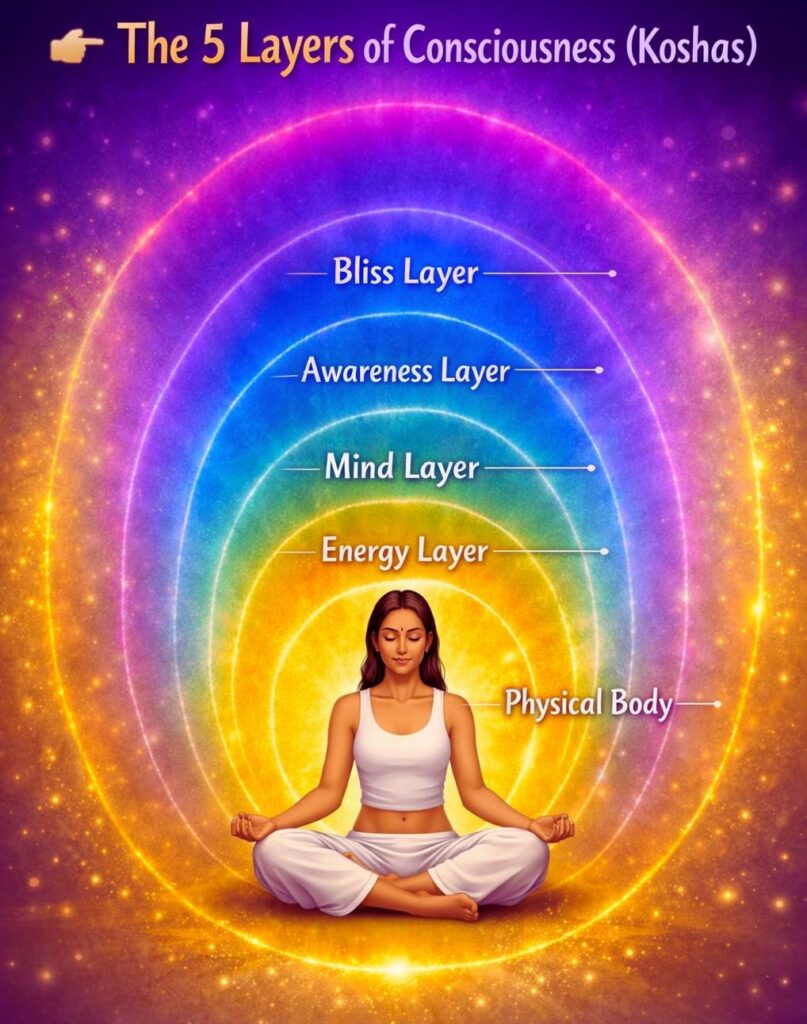
These layers move from outer to inner:
- Annamaya kosha – the physical body
- Pranamaya kosha – the energy body (breath and vital force)
- Manomaya kosha – the thinking and emotional mind
- Vijnanamaya kosha – awareness, insight, and observation
- Anandamaya kosha – a deeper state of ease and inner stillness
Most of daily life stays on the surface — the physical and mental layers.
Sleep helps restore the body and, to some extent, the mind. But it does this unconsciously. The system runs its processes in the background, and you wake up without direct awareness of what happened.
You cannot guide it. You cannot observe it. You cannot access the deeper layers intentionally.
Yoga nidra works differently.
It brings you to the space between waking and sleep often called the hypnagogic state. In yoga, this is linked to pratyahara, the withdrawal of the senses inward. Research suggests this state shows patterns similar to light sleep while maintaining awareness, making it a unique form of conscious rest.
Here, something unique happens:
- the body is deeply relaxed
- the mind becomes quiet but aware
- the nervous system shifts out of stress mode
- deeper layers of tension begin to surface and release
You are not asleep, but you are no longer in ordinary waking awareness either.
This is why even a 20–30 minute practice can feel surprisingly restorative.
It is not because you were sleeping.
It is because you accessed a level of rest that waking life rarely reaches — and that sleep only touches unconsciously, without intention.
What yoga nidra does that sleep does not
Yoga nidra offers forms of rest and recovery that sleep alone cannot provide especially during the day and at deeper mental levels.
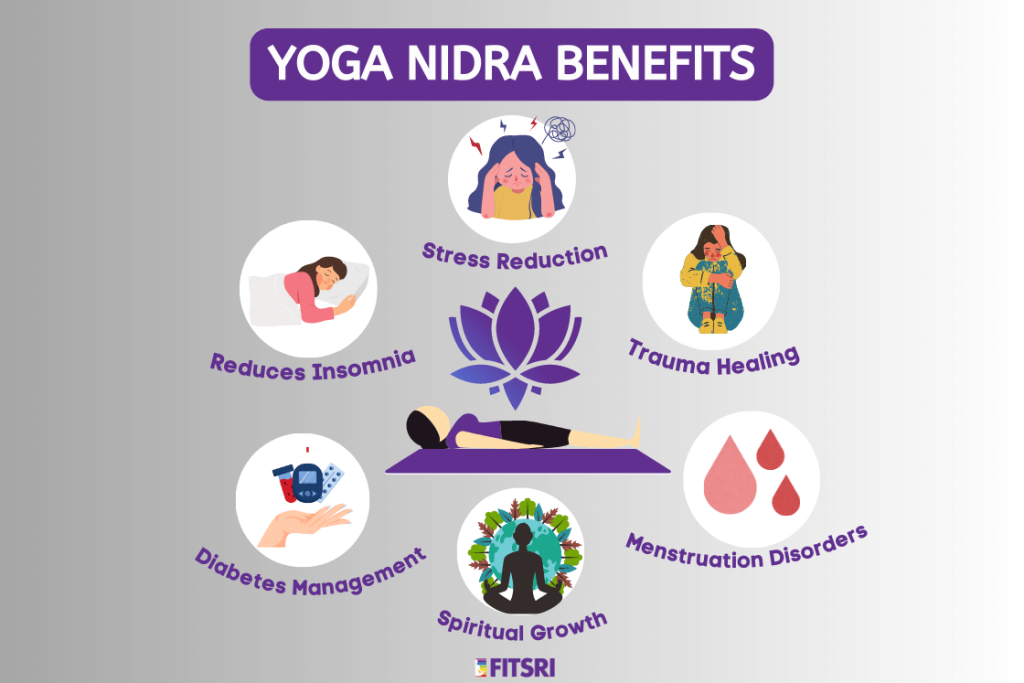
1. Calms the nervous system during the day
Sleep happens at night, within a fixed biological rhythm.
Yoga nidra is available when you actually need it — like mid-afternoon, when cortisol is still elevated and the mind is active.
It gives the nervous system a chance to reset before stress builds up further.
2. Releases deep physical and energetic tension
Chronic tension often shows up as:
- tight shoulders
- clenched jaw
- restricted breathing
- a constantly braced chest
This tension is not just muscular — in yogic terms, it is also held in the pranamaya kosha (energy body).
Sleep does not always fully release this.
A guided yoga nidra practice, moving awareness slowly through the body, helps these areas soften in a more conscious and complete way.
3. Works with the subconscious mind (Sankalpa)
Yoga nidra allows you to introduce a sankalpa (intention) when the mind is deeply relaxed.
At this point:
- mental resistance is low
- awareness is present
- the subconscious is more receptive
This state is not available during sleep.
You cannot guide the sleeping mind — but in yoga nidra, you can.
4. Prevents stress from accumulating
Sleep is primarily reparative. It works on what the day has already exhausted.
Yoga nidra works earlier in the cycle.
Practising in the afternoon or early evening can:
- reduce stress buildup
- lower mental fatigue
- prevent overload before bedtime
It acts more like maintenance, not just recovery.
5. Supports people who struggle with sleep
For those dealing with:
- insomnia
- anxiety
- hypervigilance
- nervous system dysregulation
Deep sleep is not always easy to access.
Yoga nidra does not require you to fall asleep.
It offers a form of rest that is available even when sleep is not.
Why this matters
Sleep restores the body.
Yoga nidra helps regulate the system before deeper imbalance builds.
Used together, they create a more complete approach to recovery not just repairing damage, but reducing how much accumulates in the first place.
When to use yoga nidra vs sleep (and why one cannot replace the other)
If you slept five hours last night, a 20-minute yoga nidra practice this afternoon will help you function better. It will reduce cortisol, settle the nervous system, and clear some cognitive fog. But it will not complete the glymphatic clearance that the missing sleep left unfinished. It will not restore the growth hormone secretion. It will not consolidate yesterday’s memory formation.
Yoga nidra supports sleep. It does not justify shortchanging it.
On the other hand, if sleep is adequate on paper seven hours, consistent schedule — but the body still feels chronically exhausted, wired but tired, or holding tension that no amount of rest seems to release, that is often a signal that the pranamaya kosha is depleted in a way that unconscious sleep is simply not reaching. That is the situation where yoga nidra shifts from supplementary to essential.
The practitioners who tend to change most significantly through a consistent yoga nidra practice are not always the ones who were sleep-deprived. Often they were sleeping reasonably well and still running on empty. The deficit was not in sleep quantity. It was that the deeper layers were receiving no conscious attention at all.
How to use yoga nidra and sleep together
Sleep is the foundation. Protect it. Seven to nine hours for most adults, consistent timing, a dark and cool environment. These are not negotiable if you want the physiological maintenance that only sleep can provide.
Yoga nidra is the layer work — the practice that reaches what sleep cannot. Ten to thirty minutes, ideally in the early-to-mid afternoon or in the transitional window between work and evening. This is where the deeper restoration happens: the dissolution of chronic tension, the planting of intention, the conscious contact with layers of the self that daily life never reaches.
If sleep quality is poor, yoga nidra practiced before bed is not a replacement it is preparation. A nervous system that has already been brought down through yoga nidra enters sleep in a fundamentally different state. Many practitioners find that sleep quality improves noticeably within weeks of regular practice, not because one replaces the other, but because a calmer nervous system allows the body to move through deeper sleep stages more efficiently.
What the western idea of NSDR misses
Non-Sleep Deep Rest is a useful entry point. The neuroscience behind it is real, and the term gave a lot of people a reason to try something that genuinely helps them.
But framing yoga nidra primarily as a recovery optimization tool a way to rest more efficiently, need less sleep, or perform better strips away the dimension that makes the practice most transformative over time.
Yoga nidra practiced with a sankalpa, with consistency, and with real understanding of the koshas is not just a nervous system reset. It is a practice of self-knowledge. The deeper the practice goes, the more the practitioner begins to recognize the layers that normally operate entirely below awareness — the habitual emotional tones, the stored impressions, the tendencies that shape behaviour without conscious consent.
Sleep cannot offer that. Sleep takes you under. Yoga nidra takes you in.
Both matter. Both serve the whole person. But a life that only includes sleep is a life receiving roughly half the rest that is actually available to it.
Yoga nidra vs sleep: the honest answer
Yoga nidra is not better than sleep for rest and recovery.
Sleep is not better than yoga nidra.
They are not in competition.
Sleep repairs the body and brain through essential biological processes that cannot be replaced. Yoga nidra works on a different level restoring the nervous system, reducing mental tension, and bringing awareness to deeper layers of the mind.
If you are short on time and have to choose in the moment, choose sleep.
The body’s physical recovery cannot be postponed for long.
But if the question is what lies beyond what sleep alone provides the answer is: more than most people realise.
Even 10 minutes of yoga nidra, practised in stillness with guided awareness, can shift how your body feels and how your mind settles.
That experience will answer the question more clearly than any explanation.
If you want to experience this more deeply
Reading gives you understanding.
Practice gives you the experience.
If you want to go beyond just trying a short session and actually learn how yoga nidra works step by step, you can join our 6-day live Yoga Nidra workshop.
Inside the workshop, you’ll learn:
- how to enter the state of yoga nidra properly
- how to use sankalpa effectively
- how to relax the body and nervous system in a guided way
- how to build a consistent personal practice
Each day includes a live 1.5-hour session, along with recordings so you can revisit the practice anytime.
This is designed for beginners as well as those who want to deepen their understanding.
👉 If you feel like this practice resonates with you, this is the best place to start.